Lamborghini Countach: The Poster We All Had on the Wall
on
Some cars you remember from the day you saw them on the street. Others you remember from the wall of your childhood bedroom. For a whole generation, the Lamborghini Countach belongs to the second kind. Most kids of the ’80s had never seen one up close. But they had it on a poster, as a scale model, on a school notebook, in a sticker album. For us, “supercar” meant Countach. Full stop.
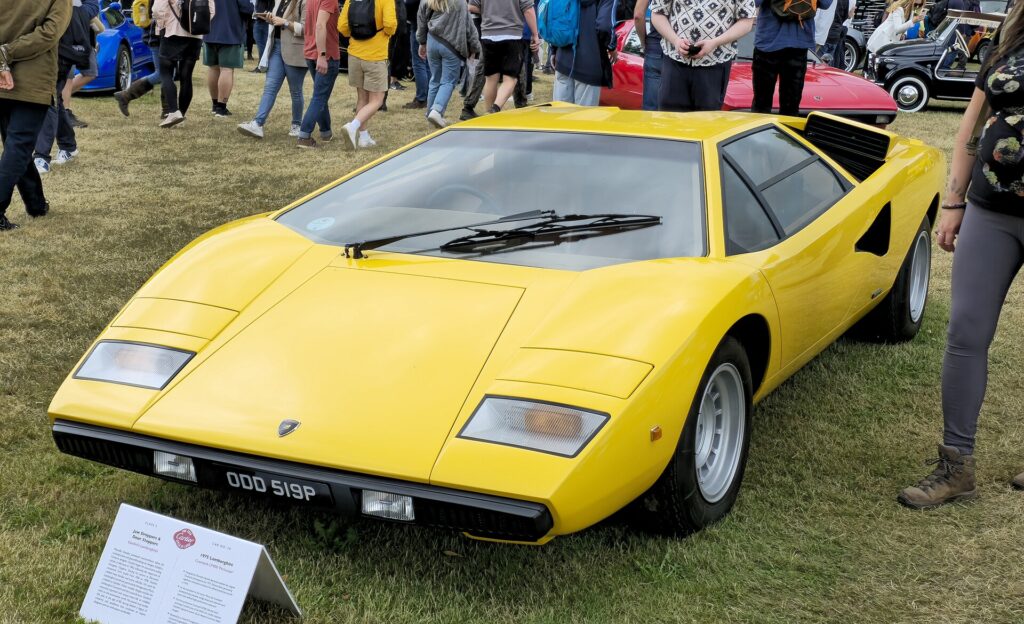
Countach LP400 ‘Periscopio’ of 1975, the purest form of Gandini’s design.
Photo: Calreyn88 / Wikimedia Commons, CC BY-SA 4.0
On this site I’ve written about the Miura and about Lamborghini’s engines. The Countach is the next chapter, and perhaps the most theatrical.
A Piedmontese word of amazement
By the early ’70s the Miura was starting to age and Ferrari had launched the Daytona. Ferruccio Lamborghini and his chief engineer Paolo Stanzani wanted a successor that would make the Miura look conservative. The body was entrusted once again to Bertone and to Marcello Gandini, the same man who had just designed the Stratos Zero.
The name isn’t a bull’s name, as with most Lamborghinis. It’s the word contacc, an exclamation of amazement in the Piedmontese dialect, something like “wow!”. Gandini has told how a very tall craftsman in the workshop spoke almost nothing but Piedmontese, and the word started being used as a joke during the late nights before the show. They asked Bob Wallace, Lamborghini’s New Zealand test driver, how it sounded to an English-speaking ear. He liked it. It stuck.
Geneva 1971: the LP500
The LP500 prototype was shown at the 1971 Geneva Motor Show and people were left open-mouthed. A low, flat wedge made of straight lines and trapezoids, without a single curve to recall the Miura. And the doors: instead of opening outwards, they lifted up and forwards, like scissors. Gandini had first tried them on the 1968 Alfa Romeo Carabo concept, but with the Countach they became Lamborghini’s trademark for the next fifty years.
It took three years of work to turn the prototype into a production car. The LP400 arrived in 1974. The air scoops added for cooling spoiled the purity of the line a little, but the essence remained. Early LP400s have a small “window” in the roof so the driver can use the interior mirror, which is why they’re called “Periscopio”.
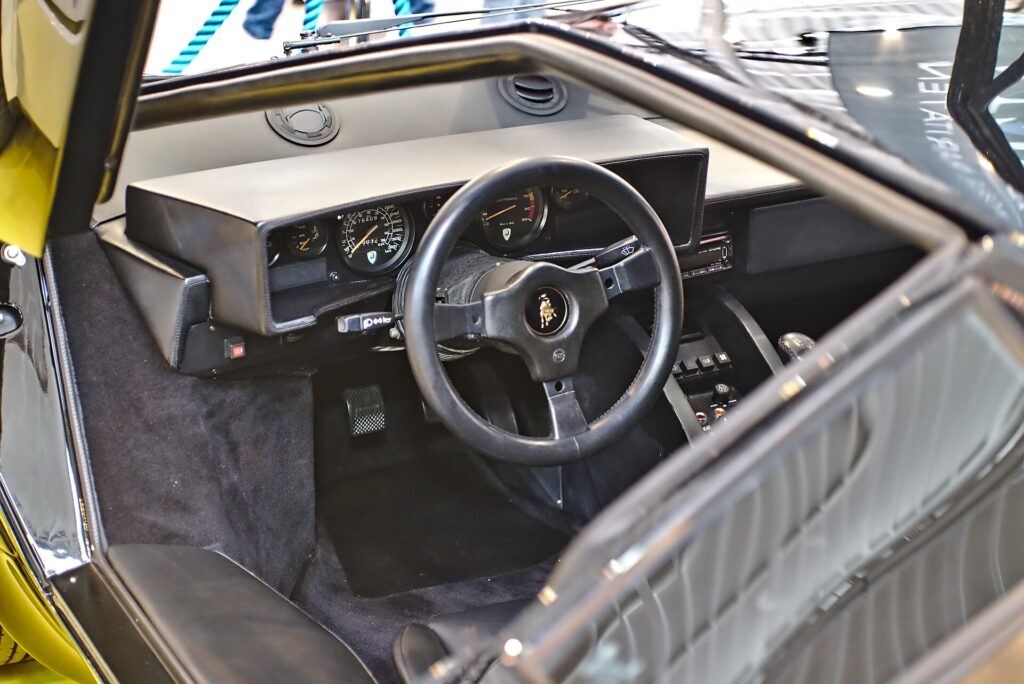
Inside the Countach: low, narrow and very Italian.
Photo: Thomas Vogt from Paderborn, Deutschland / Wikimedia Commons, CC0
The V12 that sits back to front
The cleverest engineering idea in the Countach is the one you can’t see. The Miura had its V12 mounted transversely. Stanzani turned it lengthways, but “backwards”: with the gearbox in front of the engine, between the two seats. That way the gear lever goes straight into the gearbox, with no linkages, and the weight is concentrated in the middle of the car. The LP in the name stands for longitudinale posteriore, “longitudinal rear”.
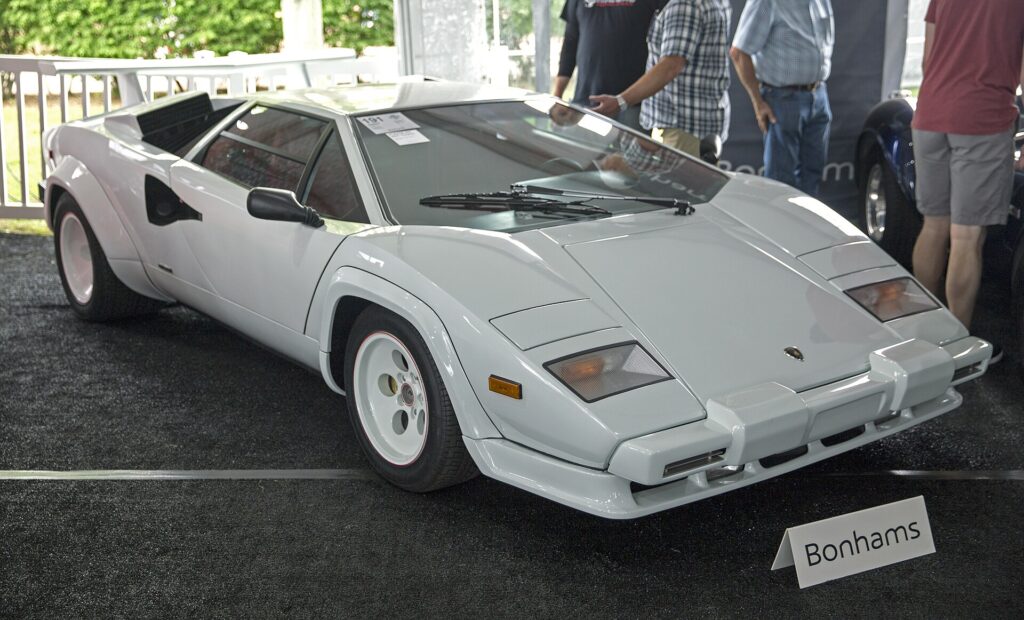
The LP400 used the 3.9-litre V12 with six Webers, because the planned 5-litre engine wasn’t yet reliable. Then came the LP400 S with the wide arches and the optional rear wing (the “poster” car we all remember), the 5000 S in 1982 with 4.8 litres, and the 5000 Quattrovalvole in 1985 with 5.2 litres and four valves per cylinder. The last version was the 25th Anniversary, and production ended in 1990.
Countach 5000 Quattrovalvole of 1986.
Photo: Mr.choppers / Wikimedia Commons, CC BY-SA 3.0
Living with one
Let’s be honest. The Countach is not an easy car. Rear visibility is almost zero, and the classic technique for reversing is to open the door, sit on the sill and look back over your shoulder. The clutch is heavy, so is the steering at low speeds, and the heat in the cabin in summer is something like a sauna. Maintaining a V12 with six carburettors needs a specialist mechanic and a deep wallet.
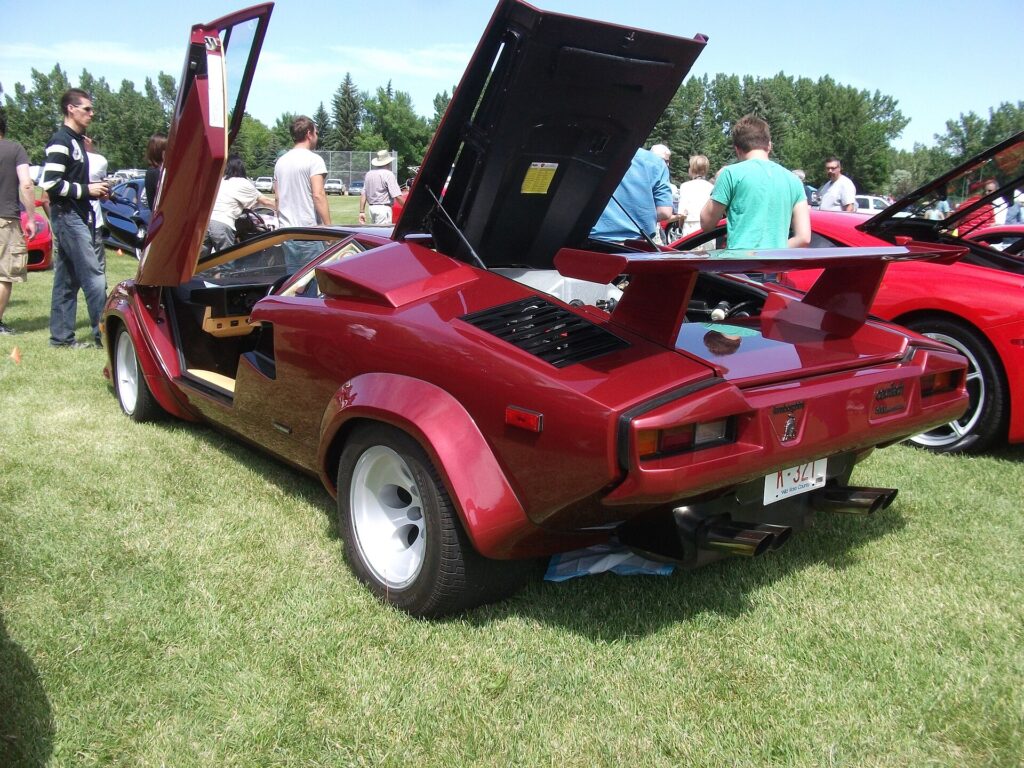
Countach 5000 QV with its scissor doors open.
Photo: dave_7 from Lethbridge, Canada / Wikimedia Commons, CC BY 2.0
None of that matters. The Countach wasn’t built to be sensible. It was built to make you stop whatever you’re doing and look at it. Fifty years later, it still does. And many of us, somewhere in an old drawer, still have that poster.
P.Kefalas
Photo Credits: Calreyn88 (Wikimedia Commons, CC BY-SA 4.0) · Mr.choppers (Wikimedia Commons, CC BY-SA 3.0) · Thomas Vogt from Paderborn, Deutschland (Wikimedia Commons, CC0) · dave_7 from Lethbridge, Canada (Wikimedia Commons, CC BY 2.0)