The Classic Mini: Three Metres of Car, Three Monte Carlo Wins
on
The Mini is one of those cars everyone has a story about. The uncle who had one once and fitted five people and a watermelon inside. The friend who threw it into every corner like a go-kart. Personally, every time I get into one, I come out with the same conclusion: I don’t understand how so much space fits into so little car. And the answer has a name. Alec Issigonis.
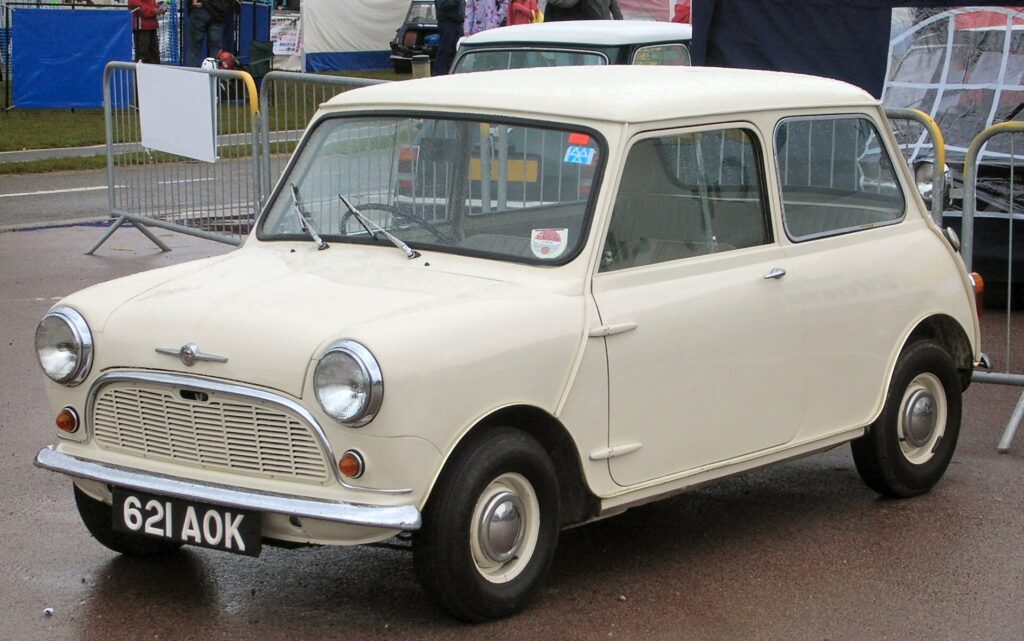
621 AOK, the first Morris Mini-Minor off the production line in 1959.
Photo: DeFacto / Wikimedia Commons, CC BY-SA 2.5
It all started with a crisis
In 1956 the Suez crisis brought petrol rationing back to Britain. Big cars sat unsold in the showrooms and people started buying German “bubble cars”, those little three-wheeled eggs. Sir Leonard Lord, the boss of BMC, got angry and gave Issigonis a clear brief: build a proper small car for four people that would drive them off the roads.
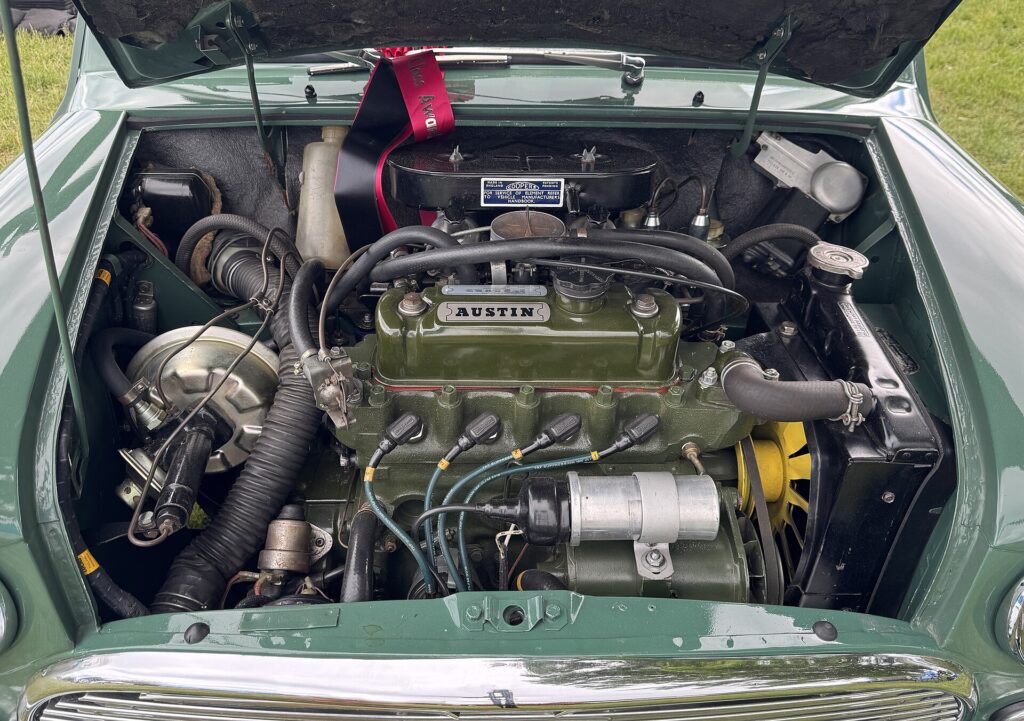
Issigonis, a Briton of Greek descent born in Smyrna, did something that sounds simple but was madness at the time. He turned the engine sideways, put the gearbox underneath it, in the sump, sharing the same oil, and drove the front wheels. That left 80% of the floor for people and luggage. Almost every small car we drive today has this layout. Whether we know it or not, we’re all driving a bit of Mini.
Wheels like a pram’s and rubber suspension
To gain even more space, Issigonis asked for 10-inch wheels. Dunlop had to make new tyres specially. The suspension, the work of his friend Alex Moulton, didn’t even have proper springs but solid rubber cones. Hard and noisy, but with those wheels at the four corners the car turned as if it were bolted to the tarmac.
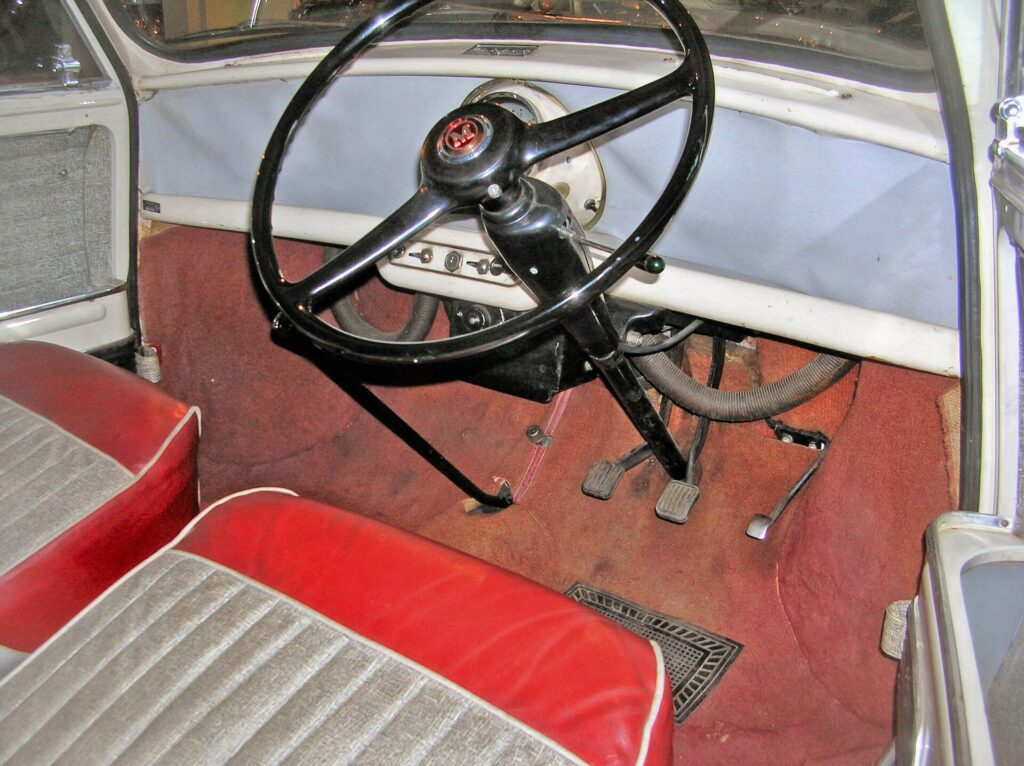
The interior was as basic as it gets. Sliding windows instead of winders, so the doors could be thin and leave room for your elbow. One round gauge in the middle of the dashboard. And big door pockets which, as the story goes, Issigonis sized to hold the bottle for his favourite cocktail. He was a man with priorities.
The spartan interior of the first Mini: one gauge in the middle and lots of space.
Photo: DeFacto / Wikimedia Commons, CC BY-SA 2.5
The Mini was launched on 26 August 1959, as the Austin Seven and the Morris Mini-Minor. The first car off the production line, registered 621 AOK, still exists and is on display at the British Motor Museum in Gaydon. It had an 848 cc engine with around 34 hp. Not much? In a car that weighed about as much as a big motorbike today, it was enough.
John Cooper and the “S”
John Cooper, who built Formula 1 cars, immediately understood what he had in his hands. He proposed a more powerful version to BMC, and so the Mini Cooper was born in 1961 and the Cooper S in 1963. The A-series engine got more capacity, front disc brakes were fitted, and the housewife’s little car suddenly became a weapon.
The 1275 cc A-series engine in a 1966 Cooper S, mounted transversely.
Photo: Mr.choppers / Wikimedia Commons, CC BY-SA 4.0
Monte Carlo: when David beat Goliath
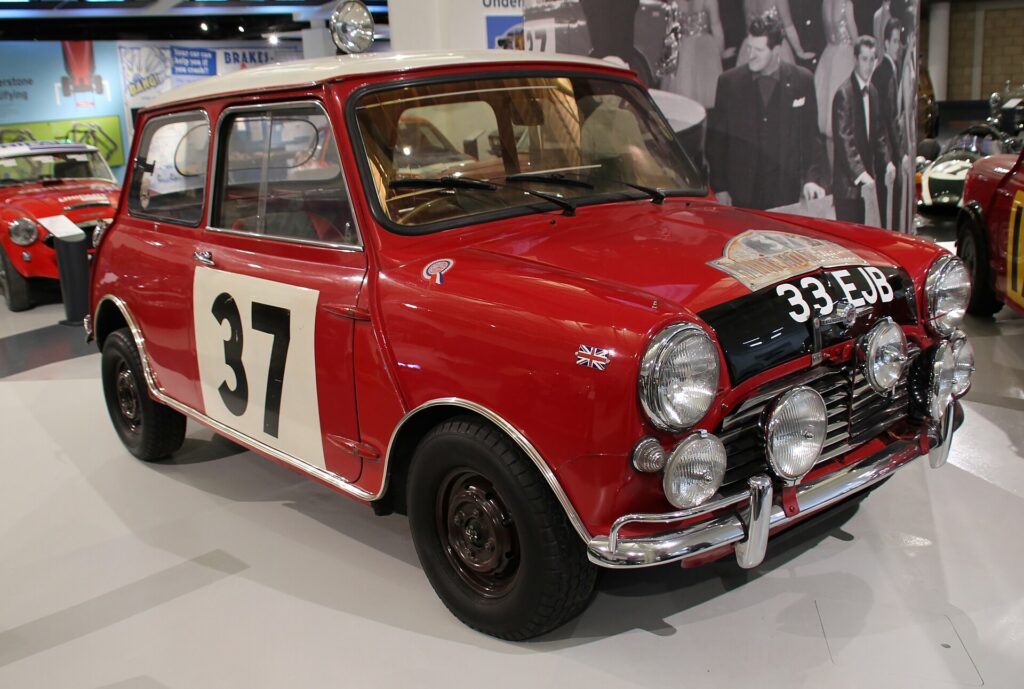
In 1964 Northern Irishman Paddy Hopkirk, in a red Cooper S with a white roof and the number 37 (registration 33 EJB), won the Monte Carlo Rally ahead of cars with two and three times the power. In 1965 Timo Mäkinen did it again. In 1966 the Minis finished first, second and third, but the organisers disqualified them over their lights, and the win went to a Citroën DS. To this day the English consider it one of the biggest injustices in rally history. In 1967 Rauno Aaltonen settled the score with the third win.
The Cooper S (33 EJB) in which Paddy Hopkirk won the 1964 Monte Carlo.
Photo: Tony Hisgett / Wikimedia Commons, CC BY 2.0
The secret was simple. On the narrow, snowy mountain roads above Monaco, the light, front-wheel-drive little car with its short wheelbase went into the hairpins where the big cars were braking. The Finnish drivers taught the world to drive it with the left foot on the brake, and the technique stuck.
Forty-one years of production
The Mini changed owners, names and versions (Clubman, Moke, van, pick-up), but in essence it remained the same car until October 2000. In total, around 5.38 million were built. Anyone looking for one today should check the sills, the floor and the subframes first, because rust loves it as much as we do. And they should know they’re not just buying a small car. They’re buying the car that showed everyone else how it’s done.
P.Kefalas
Photo Credits: DeFacto (Wikimedia Commons, CC BY-SA 2.5) · Tony Hisgett (Wikimedia Commons, CC BY 2.0) · Mr.choppers (Wikimedia Commons, CC BY-SA 4.0) · DeFacto (Wikimedia Commons, CC BY-SA 2.5)