Fiat 500 (1957–1975): Five Hundred Cubic Centimetres of Italian Smile
on
Have you noticed what people do when an old Fiat 500 goes by? They smile. They don’t decide to, it just happens. Old people, children, tourists, even the serious gentleman in the German SUV at the traffic lights. It’s one of the few cars in the world that never provokes envy, only affection. And behind this little thing lies a very serious engineering story.
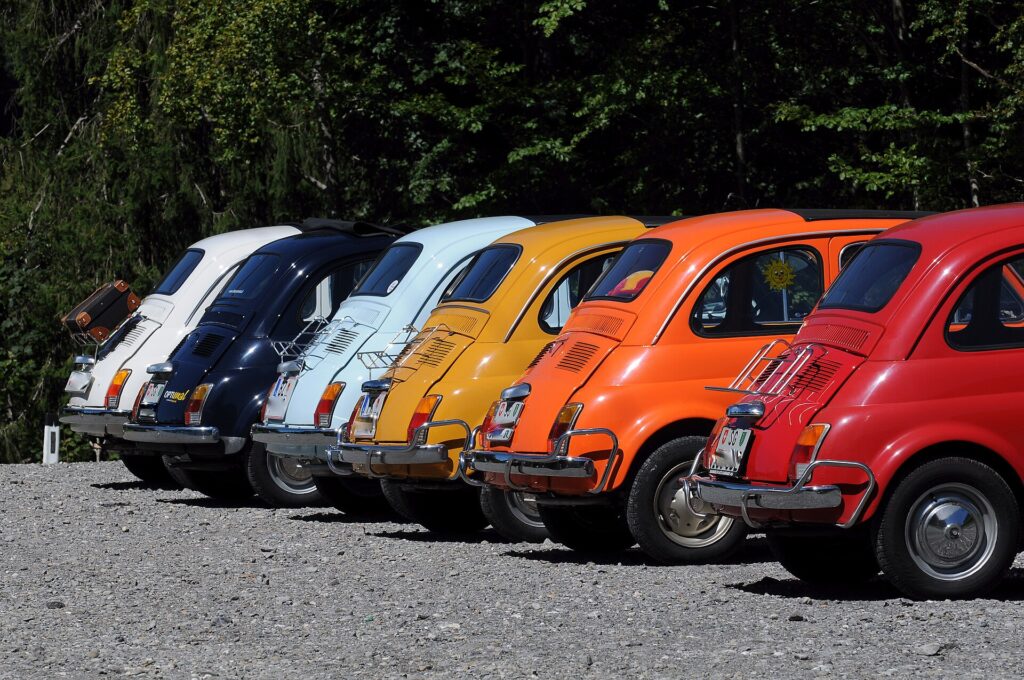
A gathering of Fiat 500s in every colour.
Photo: böhringer friedrich / Wikimedia Commons, CC BY-SA 2.5
A car for a country of scooters
Italy in the ’50s was coming out of the war and moving on two wheels. Vespas, Lambrettas, motorcycles. Fiat already had the 600 from 1955, but it needed something even cheaper, something to get Italians off their scooters without selling their house. The job went to Dante Giacosa, the engineer who had also designed the pre-war “Topolino”.
Giacosa did something very clever: he didn’t try to shrink a normal car. He started from the bare minimum. Engine at the back, so no propshaft was needed. Air-cooled, so no radiator, water or hoses. Two cylinders, 479 cc, 13 hp. Length 2.97 metres. A canvas roof that folded all the way back, because canvas was cheaper than steel. Every decision had a logic, and the logic was always the same: keep the cost down.
A difficult start
The Nuova 500 was unveiled in July 1957 and, to be honest, it didn’t go well at first. People found it too basic and too weak. Fiat reacted quickly: more horsepower, a little more equipment, a better-trimmed version. In 1958 came the 500 Sport with 499.5 cc and 21.5 hp, good for over 105 km/h. From then on sales took off. In 1959 Giacosa received the Compasso d’Oro for the 500, Italy’s most important industrial design award. It was the first time the prize had gone to a car maker.
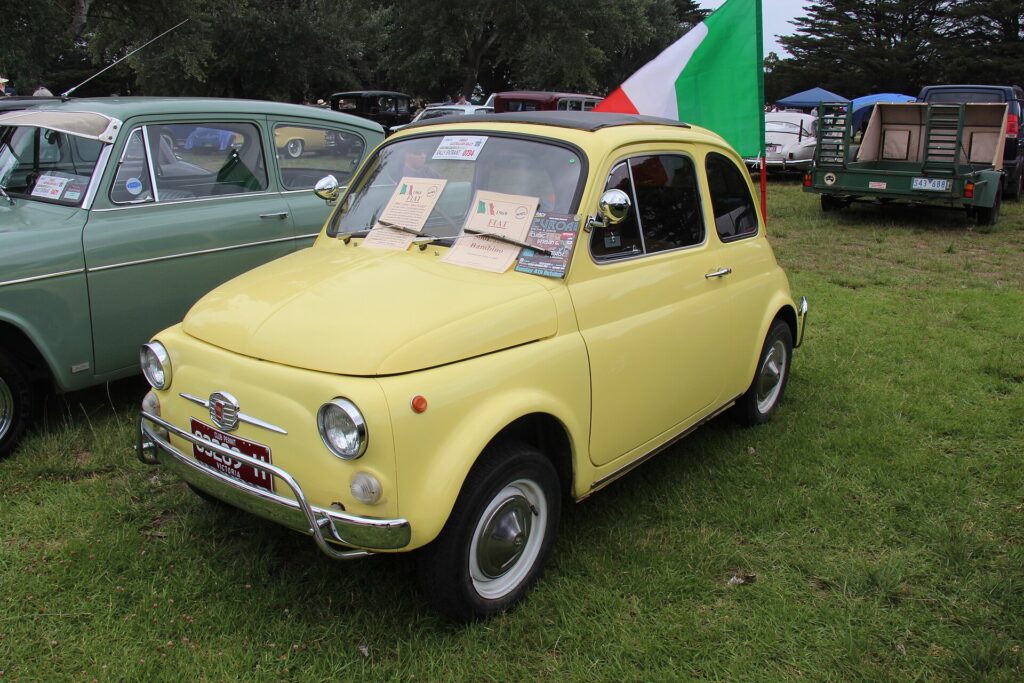
A 1969 Fiat 500 L, the ‘luxury’ version with the tubular bumper guards.
Photo: Sicnag / Wikimedia Commons, CC BY 2.0
The versions you need to know
The 1960 500 D got the 499 cc engine with 17 hp, which stayed almost to the end. It still had the doors hinged at the back, the so-called “suicide doors”. The 1965 500 F changed the doors to conventional ones and strengthened the car mechanically, and the 1968 500 L (Lusso) brought a touch of luxury: tubular bumper guards, a better dashboard, nicer seats. The last was the 500 R, from 1972 to 1975, with a 594 cc engine.
There’s also the Giardiniera, the tiny estate, with the engine laid on its side under the floor to keep the load area flat. And of course the Abarths, which took this good-natured little car and made it growl, with the engine lid propped half open so it could breathe.
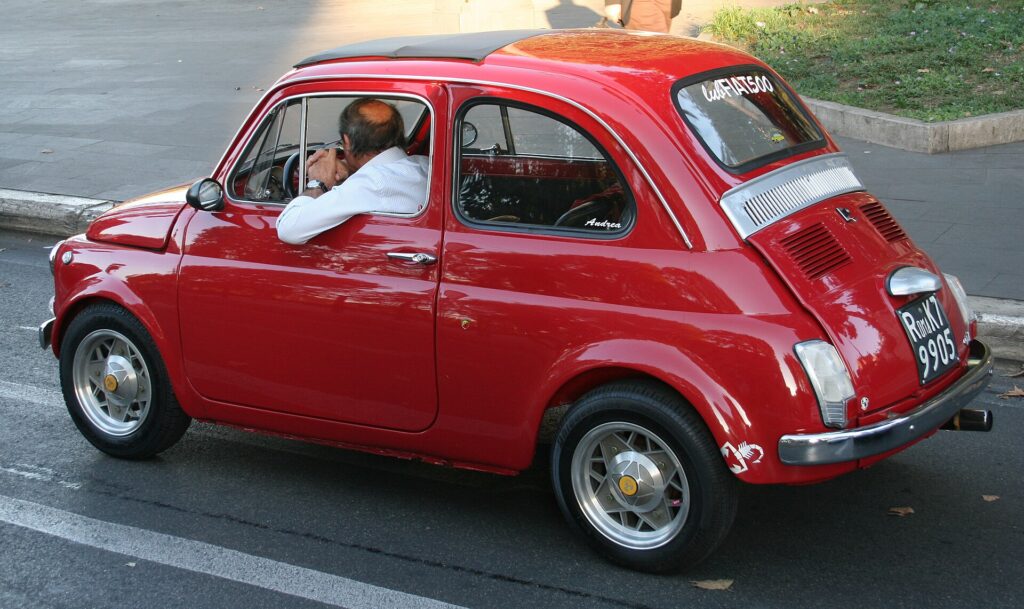
A Fiat 500 on the streets of Rome, where it belongs.
Photo: Jean-Pol GRANDMONT / Wikimedia Commons, CC BY-SA 3.0
What to look out for if you want one
From 1957 to 1975 almost four million were built, so it’s not a hard car to find, and parts are easy and cheap to get. Mechanically it’s as simple as a lawnmower, and a basic mechanic can keep it running. Rust, again, is the enemy: floor, sills, the areas under the windows, the front panel and the area around the battery. And since many have been through “restorations” with lots of filler, a magnet in your pocket will save you from nasty surprises.
Be realistic too. With 18 hp the car climbs hills patiently, and on the motorway everyone will overtake you. But the 500 wasn’t made for the motorway. It was made for narrow alleys, islands, villages, a drive to the beach with the canvas roof open. There it has no rival.
In 2007, fifty years later, Fiat launched a new 500 that looks like it on the outside. It’s a good car. But when I see one of the old ones, with the twin clattering away at the back, I know which of the two will make me smile.
P.Kefalas
Photo Credits: böhringer friedrich (Wikimedia Commons, CC BY-SA 2.5) · Sicnag (Wikimedia Commons, CC BY 2.0) · Jean-Pol GRANDMONT (Wikimedia Commons, CC BY-SA 3.0)