I don’t know if there’s a Greek or Cypriot over a certain age who hasn’t sat in the back seat of a W123. In Athens taxis, in Cyprus service taxis, on the islands, in villages, everywhere. Beige or white, with worry beads hanging from the mirror, the driver delivering political analysis and the diesel sounding like a sewing machine. For many of us, the W123 wasn’t a car. It was “the Mercedes”. Full stop.
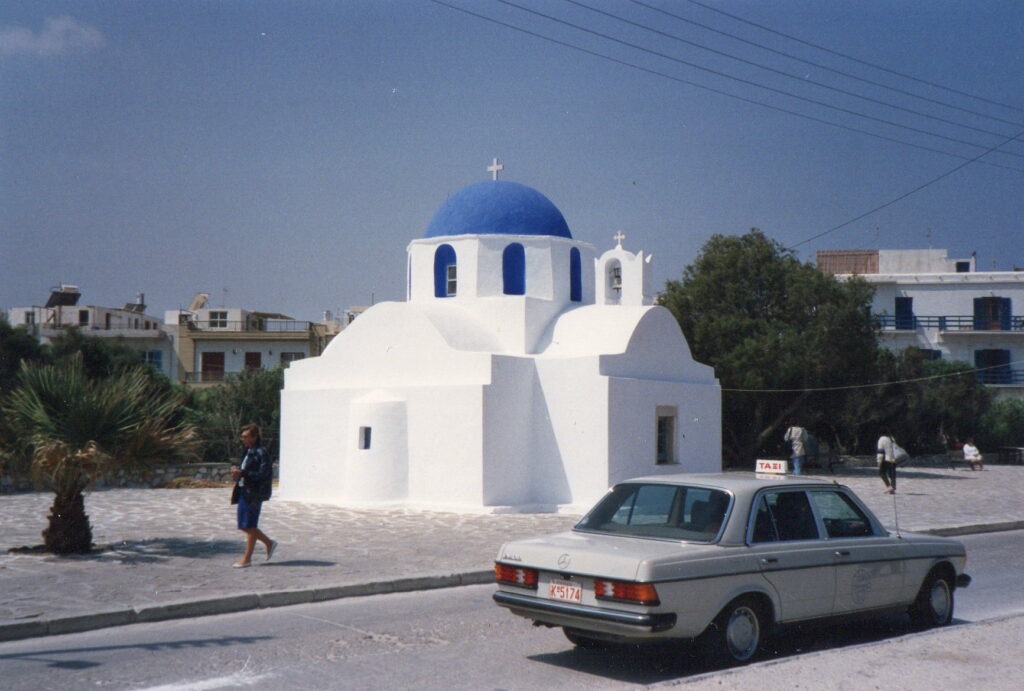
A W123 taxi in Parikia, Paros, in 1989.
Photo: Andrew Bone from Weymouth, England / Wikimedia Commons, CC BY 2.0
The photo above is from Parikia on Paros, in 1989. Look at it and tell me you didn’t smell diesel and sea salt at the same time.
A car with a waiting list
The W123 was presented at the beginning of 1976 (production had started in November 1975) and replaced the W114/W115 series. Its design, with Friedrich Geiger heading the styling department, took cues from the big W116 S-Class: horizontal headlamps, wide ribbed tail lights, clean lines. Nothing showy. Chief engineer Hans Scherenberg asked for a shape that was “balanced and non-aggressive”. Fifty years later, that’s exactly what we see.
Demand was such that at first customers waited nine to twelve months for delivery. In Germany a black market emerged: an almost new W123 sold for about 5,000 marks over list price, simply because it was available immediately. Think about that for a moment. A used car more expensive than a new one.
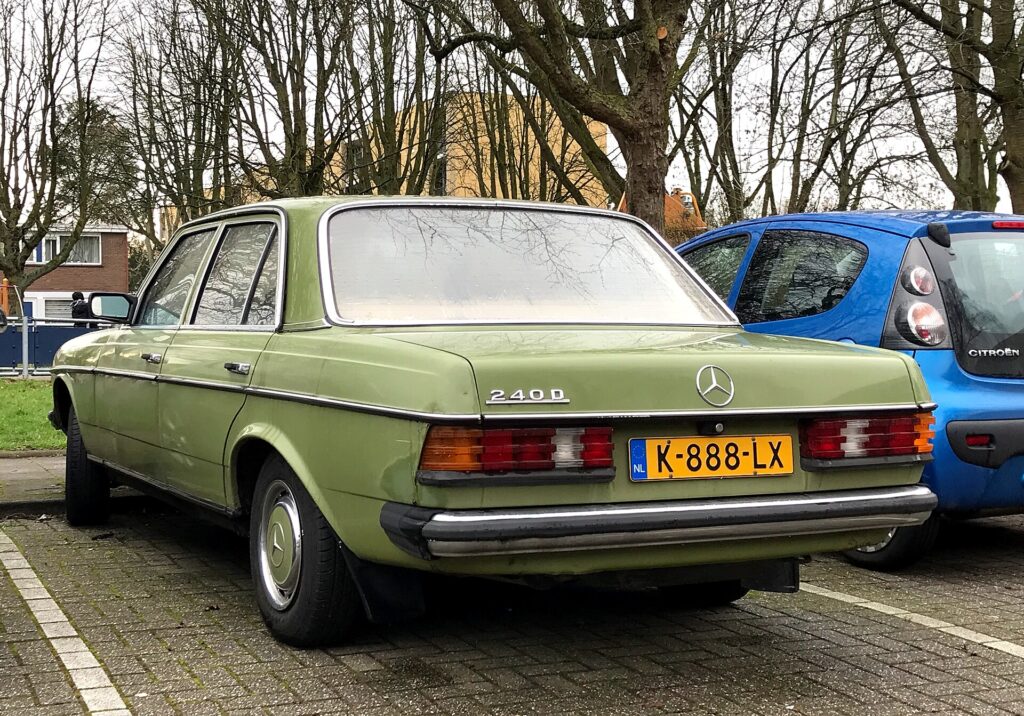
A 1980 Mercedes-Benz 240 D (W123).
Photo: Rutger van der Maar / Wikimedia Commons, CC BY 2.0
Diesel for every job
The range had petrol engines from the 200 to the six-cylinder 280 E, but the W123 became a legend with its diesels. The 200 D had around 55 hp and was, let’s say politely, relaxed. You measured 0–100 with a calendar. The 240 D was a little better, and the five-cylinder 300 D gave the car some dignity on hills. Later came a turbodiesel, mainly for America. Nobody bought them for speed. They bought them so they would never stop.
And they didn’t stop. In Germany W123 taxis often reached 500,000 kilometres with very few mechanical problems. When their life there was over, they were loaded onto ships for Africa and the Middle East, and started a second career on dirt roads. In many countries they’re still running. The most popular model was the 240 D, with 455,000 built, followed by the 230 E and the 200 D.
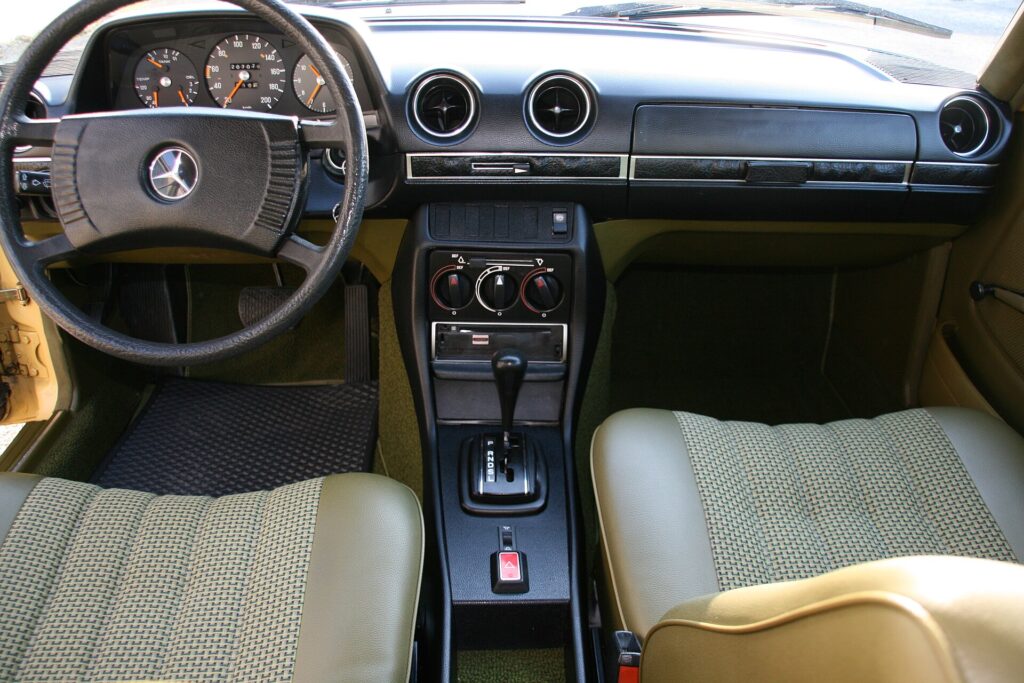
The dashboard of a first-series W123 230 (1977).
Photo: HLW at de.wikipedia / Wikimedia Commons, CC BY-SA 3.0
Not just saloons
In 1977 came the C123 coupé, with a shorter wheelbase and no pillar between the windows, one of the most elegant cars Mercedes ever made in my opinion. The same year the S123 estate was presented, the brand’s first factory estate car, with the “T” in its name. There was also the long version with seven or eight seats, which we saw at hotels, funerals and as service taxis, as well as a chassis for ambulances.
When production ended in January 1986, around 2.7 million W123s had been built. It was, up to then, the most successful Mercedes of all time.
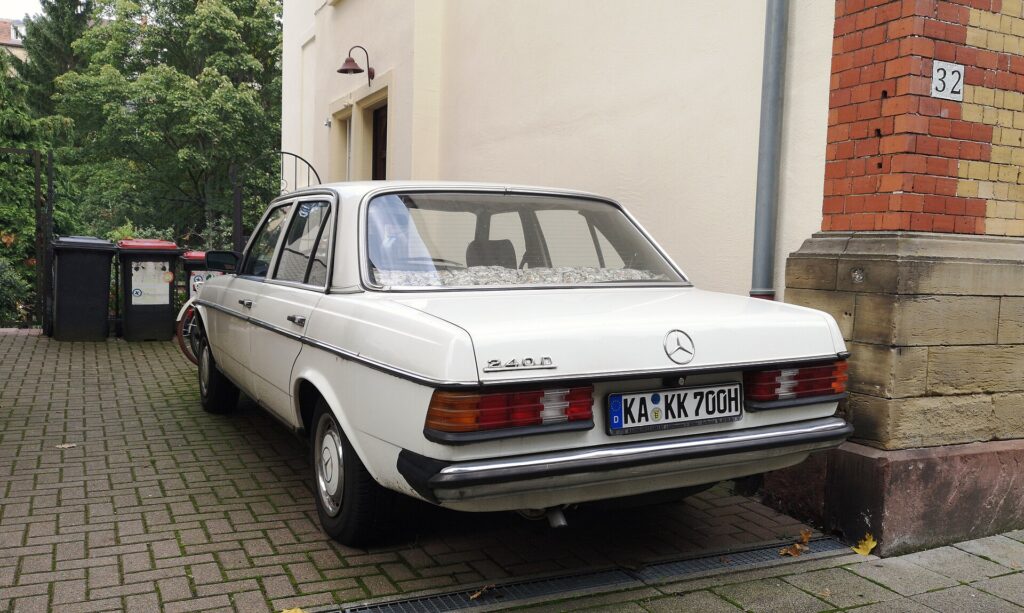
A white 240 D, the most popular version of the W123.
Photo: crash71100 / Wikimedia Commons, CC0
Buying a W123 today
The good thing about the W123 is that there are still plenty around and parts are available. The bad thing is that most have done mileage the odometer no longer shows. The engines are rarely the problem. Rust is: check the headlamp bowls, the jacking points, the bottoms of the doors, the rear arches and the floor under the mats. See whether the vacuum central locking works, because its leaks drive people mad.
And if you find a good one, with papers and service history, don’t haggle too hard. Good W123s won’t get any more numerous. Every time I close the door of a W123 and hear that heavy, confident “clack”, I understand why taxi drivers kept them until they fell apart.
P.Kefalas
Photo Credits: Rutger van der Maar (Wikimedia Commons, CC BY 2.0) · crash71100 (Wikimedia Commons, CC0) · HLW at de.wikipedia (Wikimedia Commons, CC BY-SA 3.0) · Andrew Bone from Weymouth, England (Wikimedia Commons, CC BY 2.0)