BMW M3 E30: The Four-Cylinder Built for the Track That Won Over the Road
on
There’s a category of car I particularly love: the so-called homologation specials. Cars a company built not because marketing asked for them, but because the rulebook did. To race, you had to sell a certain number to the public. Lancia did it with the Stratos and the Integrale. BMW did it with the first M3. And without knowing it, it built one of the best driver’s cars of all time.
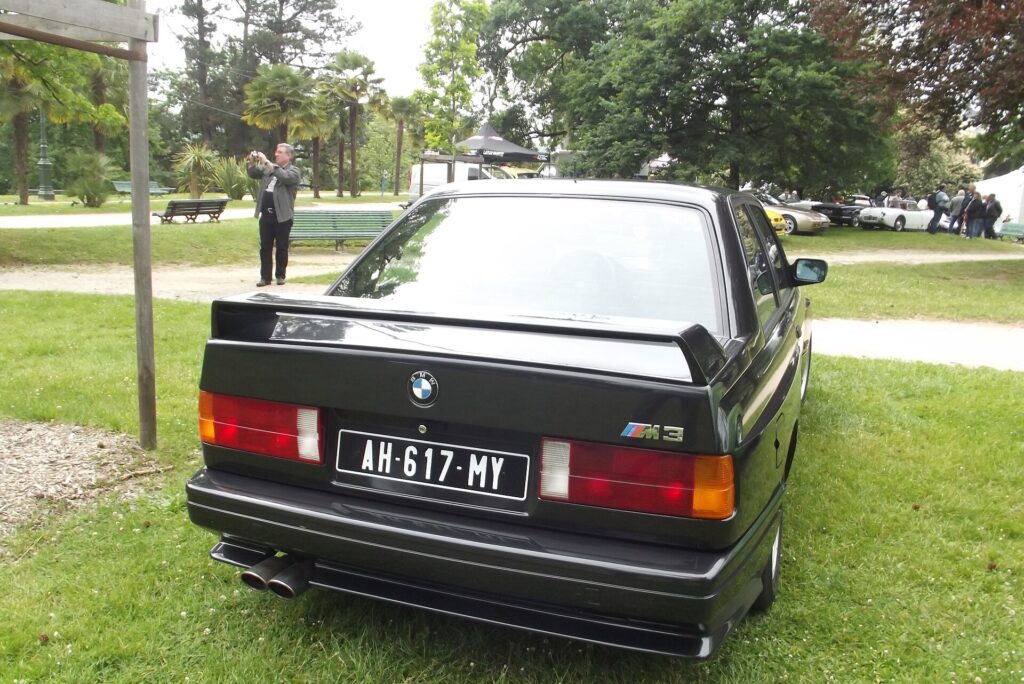
BMW M3 E30: note the higher rear pillar and the spoiler.
Photo: Handelsgeselschaft / Wikimedia Commons, CC BY-SA 4.0
5,000 cars for a ticket
In the mid-’80s BMW wanted to race in Group A and in the German DTM. The rules were clear: 5,000 cars of the basic version within a year, and another 500 for each “evolution”. The M3 was shown at the 1985 Frankfurt Motor Show and production started in March 1986.
At first glance it looks like a normal 3 Series of the period. Then you start to notice. The wheel arches are flared to fit wider wheels. The rear pillar has a different angle, the rear window is flatter, and the boot lid is made of glass-fibre reinforced plastic, raised by about 4 centimetres so the spoiler works better. Almost no exterior panel is shared with the ordinary E30. It’s not a kit. It’s a different car wearing the same suit.
The S14: four cylinders that wanted revs
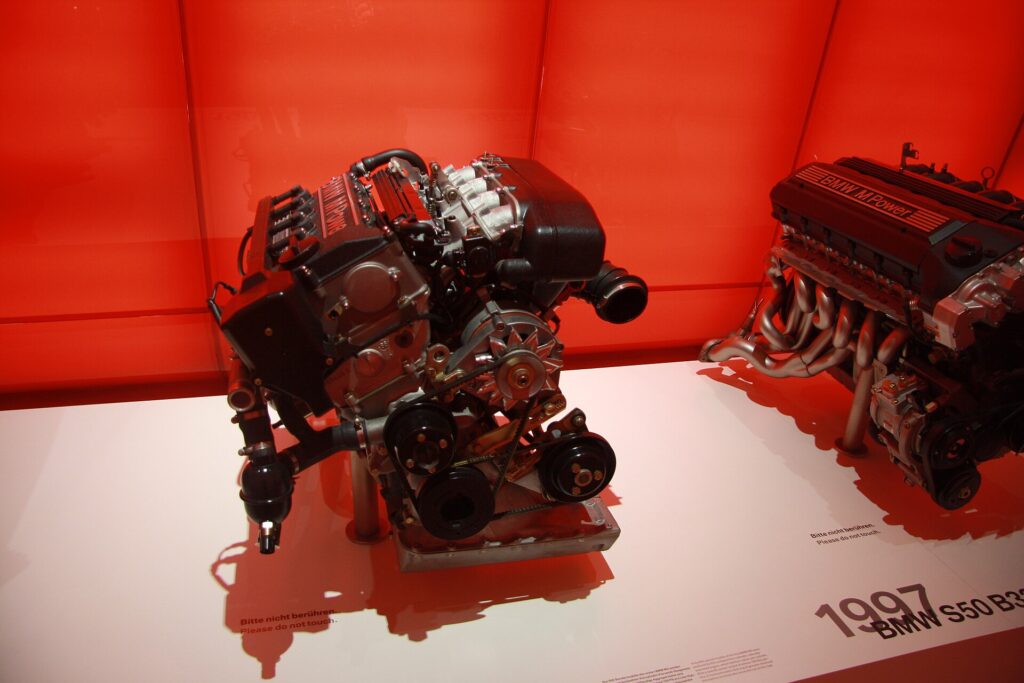
BMW had six-cylinders for the road, but for the track it wanted something lighter. So the Motorsport engineers took the block of the M10 four-cylinder and gave it a twin-cam, four-valve head that was essentially the head of the M1 and M635CSi six-cylinder cut down to four. The result was the 2.3-litre S14, with a 7,250 rpm limiter and 195 hp in catalysed form (200 without).
The S14 engine at the BMW Museum in Munich.
Photo: Jiří Sedláček / Wikimedia Commons, CC BY-SA 4.0
On the road, the numbers don’t tell the whole story. The S14 doesn’t have the torque of a six, you have to wring it out, and the M3 E30 comes alive above 4,500 rpm. The European gearbox has first gear down and to the left (the so-called “dogleg”), so that second and third, which you use constantly on track, are in a straight line. The first time you drive it you look for second and find fourth. The second time, you don’t want to drive any other gearbox.
The most successful of its time
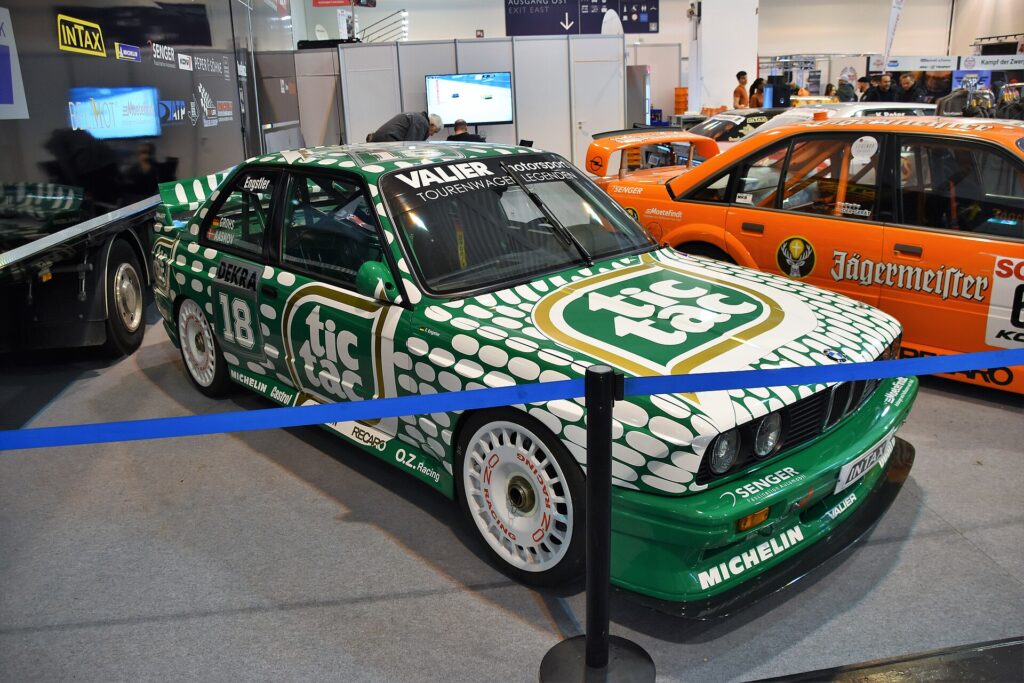
In racing the M3 did exactly what it was born for. Roberto Ravaglia won the World Touring Car Championship in 1987, and the same year Eric van de Poele won the DTM. Ravaglia took the DTM again in 1989. The M3 won the Nürburgring 24 Hours five times and the Spa 24 Hours four times. And to prove it wasn’t just for circuit tarmac, a Prodrive M3 driven by Bernard Béguin won the 1987 Tour de Corse, a round of the World Rally Championship, against four-wheel-drive cars.
A DTM-spec M3 E30 racing car (1991).
Photo: Charles from Port Chester, New York / Wikimedia Commons, CC BY 2.0
To stay competitive, BMW kept releasing evolutions: the 1987 Evolution, the Evo 2, the limited Ravaglia and Cecotto editions, and finally the 1990 Sport Evolution, with a 2.5-litre engine and 238 hp, in just 600 units. There was even a convertible, which sounds odd for a track car, but it happened. Production ended in 1991 and a total of 17,970 M3 E30s were built.
Buying today: beware of fakes
Twenty years ago an M3 E30 was an old BMW with flared arches. Today prices for good examples have gone through the roof, and that has brought something less pleasant: many ordinary E30s have been “dressed up” as M3s. Check the chassis number, the BMW certificate, whether the engine really is an S14, and whether the body panels are the correct ones. Then check for rust, especially in the rear arches, around the windows and under the battery in the boot. The S14 needs servicing and valve adjustment on time, and doesn’t forgive neglect.
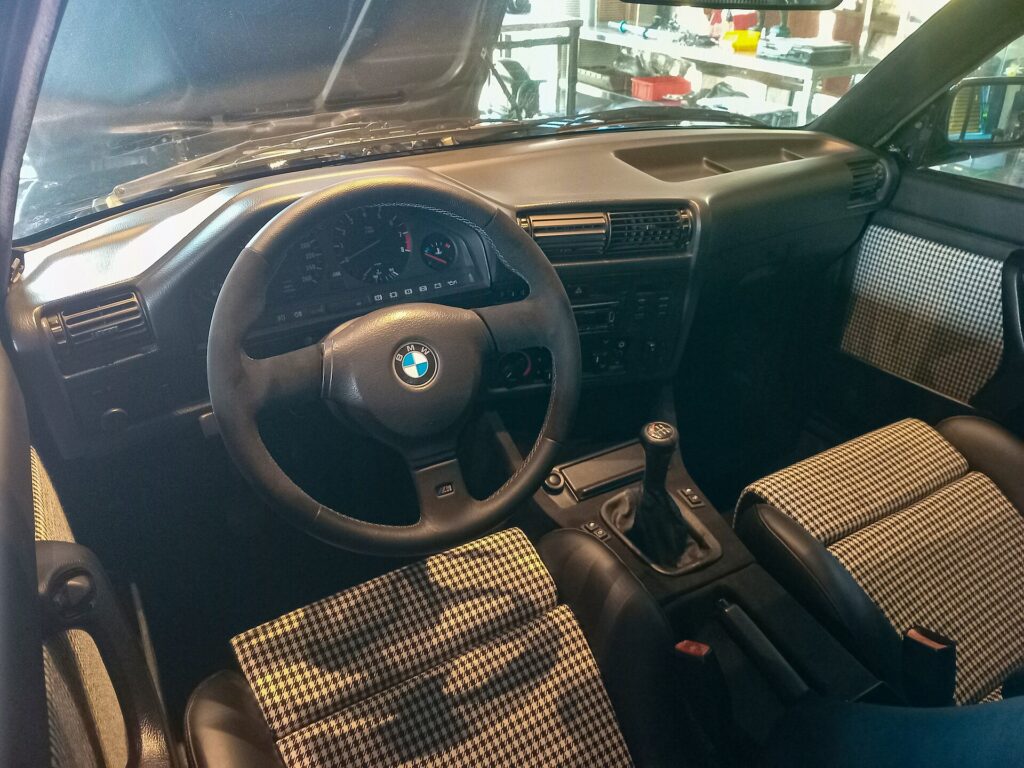
Inside an M3 E30.
Photo: Ethan Llamas / Wikimedia Commons, CC BY-SA 4.0
When everything is right, though, the M3 E30 is one of those rare cars that make you a better driver. No electronics to save you, nothing to help you. Just you, the steering wheel and a four-cylinder screaming at 7,000 rpm. You don’t need anything else.
P.Kefalas
Photo Credits: Handelsgeselschaft (Wikimedia Commons, CC BY-SA 4.0) · Jiří Sedláček (Wikimedia Commons, CC BY-SA 4.0) · Charles from Port Chester, New York (Wikimedia Commons, CC BY 2.0) · Ethan Llamas (Wikimedia Commons, CC BY-SA 4.0)