
When Americans talk about classic motorcycles, the first name they usually mention is Harley-Davidson. But for many years the largest and most innovative American motorcycle company was another one: Indian. And the motorcycle many consider the best it ever built is a light, mid-sized V-twin that lasted only four years: the 101 Scout.
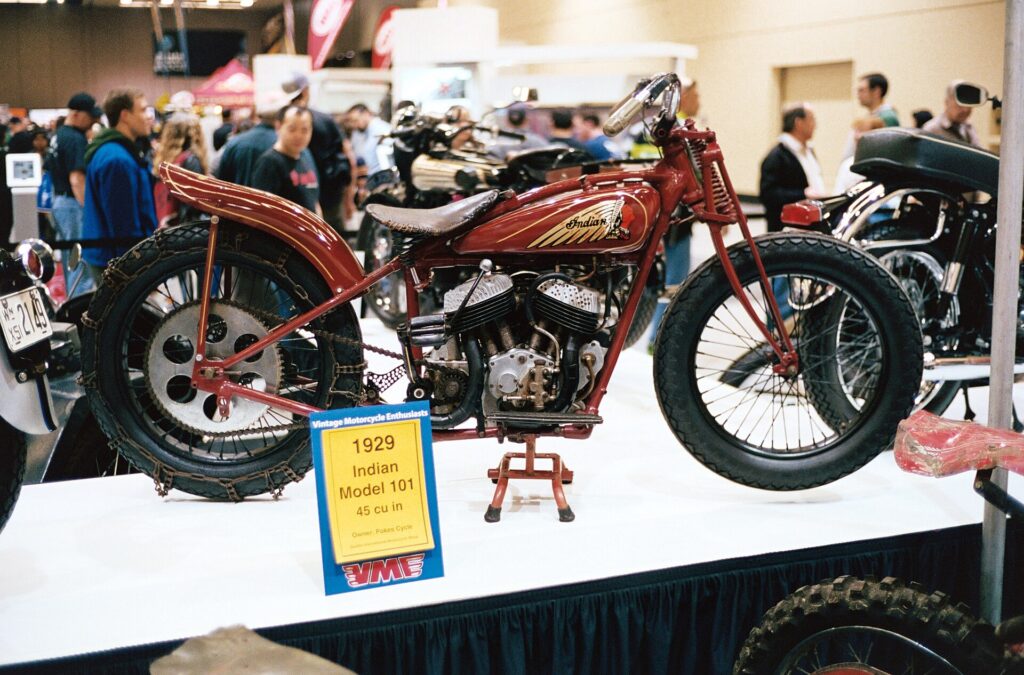
Photo: Dennis Bratland / Wikimedia Commons, CC BY-SA 3.0
The first great American brand
Indian was founded in 1901 in Springfield, Massachusetts, by George Hendee, a former cycling champion, and engineer Oscar Hedström. Before Harley-Davidson, before almost anyone, it was building motorcycles in series. In 1911 Indians took the first three places at the Isle of Man TT, which made headlines around the world. In the early 1910s it was the largest motorcycle maker in the world.
Charles Franklin’s Scout
In 1920 the Irish engineer Charles B. Franklin, a former racer, designed a new motorcycle for Indian: the Scout. It had a 600 cc V-twin, smaller than the big engines of the day, with gears instead of a chain in the primary drive, which made it almost indestructible. It was light, easy and reliable. The advertising of the time said “you can’t wear it out”.
The Scout was an instant success. It was a motorcycle that someone who was not a professional or a racer could buy and ride.
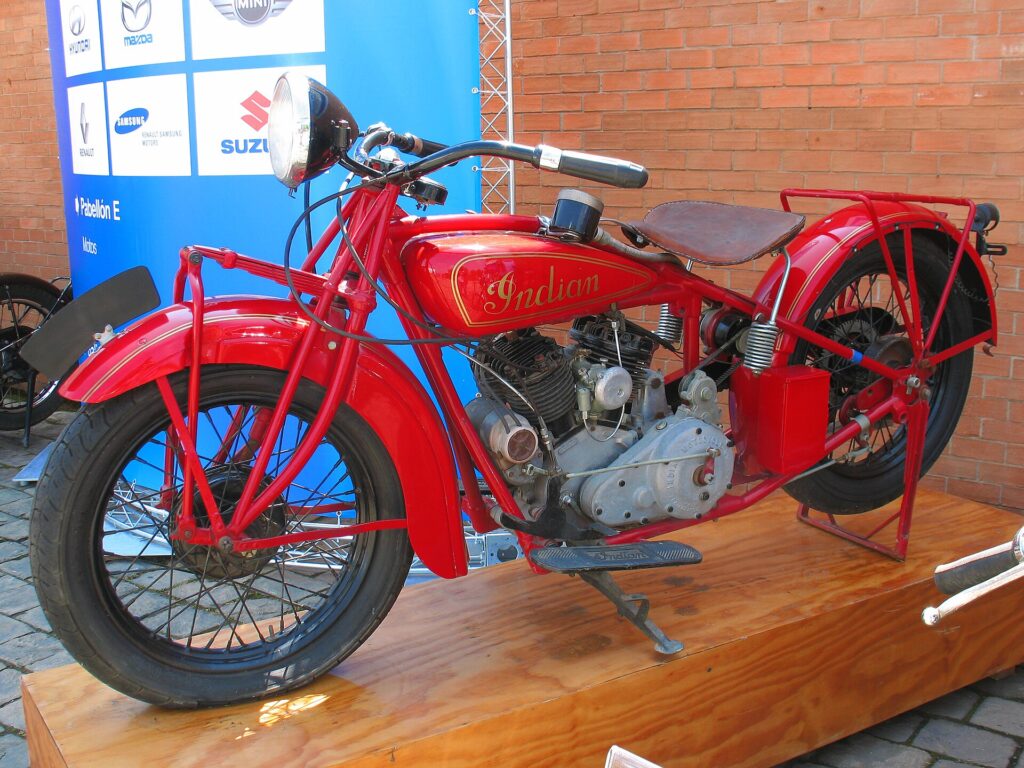
Photo: order_242 from Chile / Wikimedia Commons, CC BY-SA 2.0
101: the best Indian
In 1928 came the evolution: the 101 Scout. Franklin lengthened the wheelbase, lowered the seat, fitted a better front brake and a fork that gave the bike incredible stability. It was offered with 600 and 750 cc engines.
The result was a motorcycle that handled so well it became the favourite of “Wall of Death” riders. This was a wooden barrel with vertical walls, at fairs and circuses, where riders raced horizontally around the wall at speed. For decades, long after production ended, 101 Scouts were the first choice for these shows. Some are said to be working there still.
The end, far too soon
The 101 Scout had one problem: it was expensive to build. The 1929 crash came and Indian ran into financial trouble. In 1930 it was bought by E. Paul du Pont, of the famous chemicals family. To cut costs, in 1932 the 101 Scout was replaced by a Scout using the heavy frame of the big Chief. It was heavier and less enjoyable, and customers noticed immediately. To this day many say Indian never built such a good motorcycle again.
Burt Munro and the world’s fastest Indian
The most famous Scout, though, is not a 101. It is a 1920 Scout bought by a young New Zealander, Burt Munro. Munro worked on it in his garage in Invercargill for almost fifty years. He made his own pistons, cylinders and camshafts, often from scrap, and took the engine from 600 to around 950 cc.
In 1962, aged 63, he went to the Bonneville salt flats in the USA for the first time. In 1967, at 68, he set a record in the under-1,000 cc class at around 295 km/h (183.6 mph). That record still stands. His story became the 2005 film “The World’s Fastest Indian”, with Anthony Hopkins as Munro.
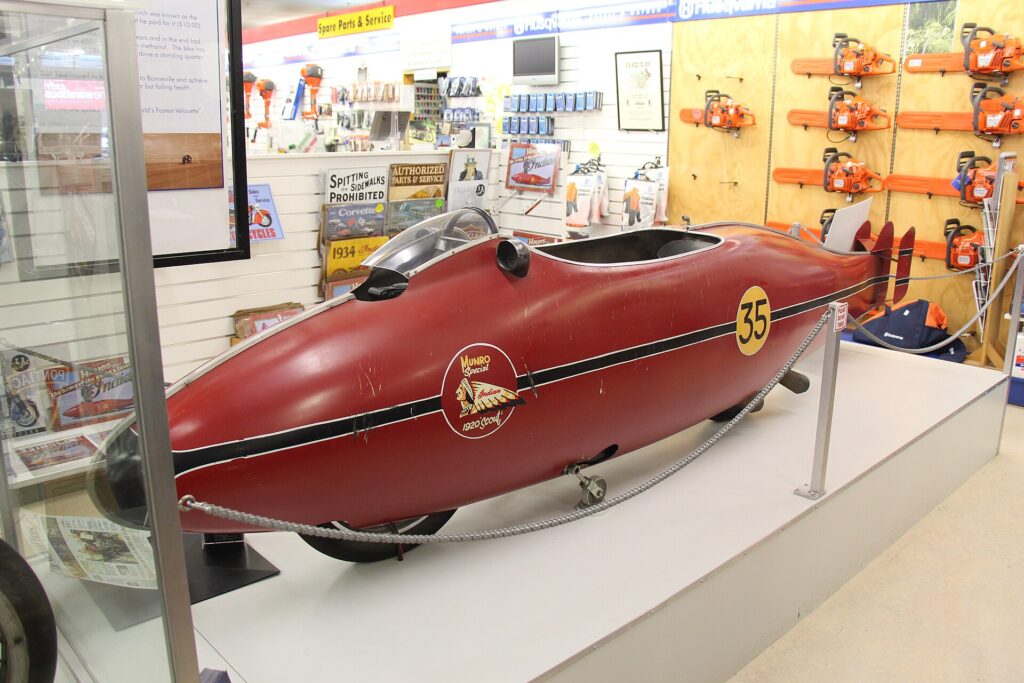
Photo: Sicnag / Wikimedia Commons, CC BY 2.0
Today a good 101 Scout is one of the most expensive pre-war American motorcycles. And Burt Munro’s Scout is on display in Invercargill, New Zealand, as a reminder that you don’t need a factory or money to make history. You need a good motorcycle and a lot of stubbornness.
P.Kefalas