Alfa Romeo Giulia GT (Bertone): The Coupé That Taught the World to Love Alfa
on
On this site I’ve written about the Montreal, the “expensive” Alfa of the ’70s. But the car that really made the world fall in love with the brand was simpler and more affordable: the 105-series coupés that we all just call the “Giulia GT” or “GTV”. If you’ve ever seen one on the road, you know it’s hard not to turn and look. If you’ve ever driven one, you know it’s even harder to give it back.
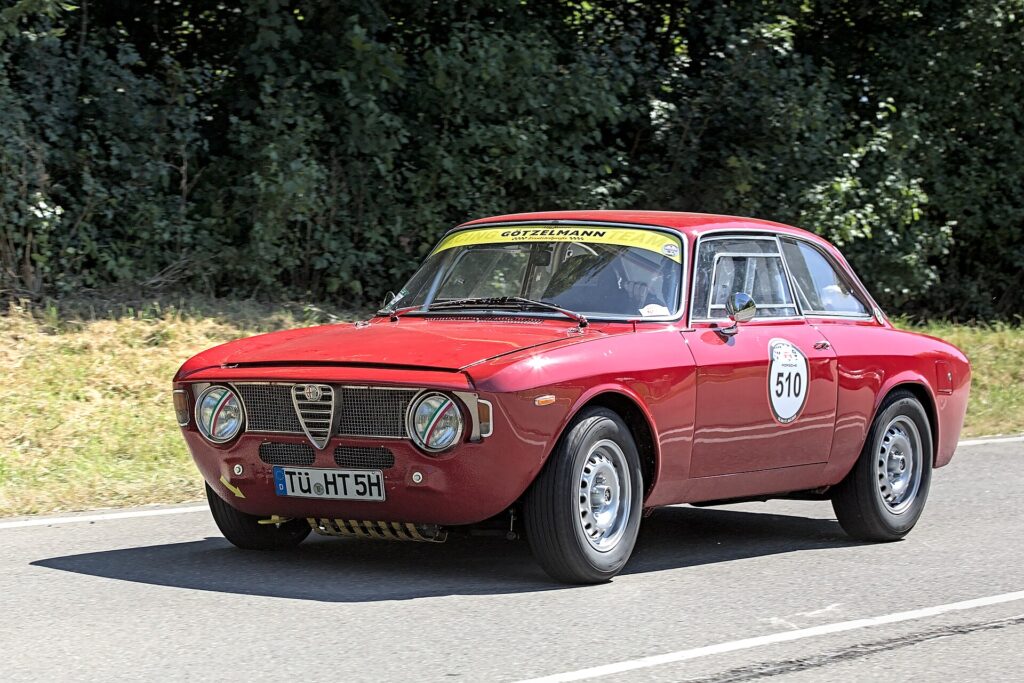
Alfa Romeo Giulia Sprint GT with the characteristic ‘step’ in the bonnet.
Photo: Alexander Migl / Wikimedia Commons, CC BY-SA 4.0
A young designer called Giugiaro
The design is the work of Giorgetto Giugiaro, who was then working at Bertone and was only in his twenties. It was one of his first major projects, long before he became the man behind the Golf Mk1 and the DeLorean. The Sprint GT had a balance between glass and metal that was new at the time: thin pillars, big windows, a cabin that seems to “float” above the body, and headlamps built into the grille.
Its most distinctive feature is what the Italians call the scalino, the “step”. The front edge of the bonnet stops slightly higher than the grille and forms a small step. Some people find it odd. I believe that without it the first Giulia GT would simply be a pretty car. With it, it has character.
The heart: the all-alloy twin cam
The Giulia Sprint GT was unveiled in September 1963 at the then brand-new Arese factory, and right after that at the Frankfurt Motor Show. Under the bonnet was Alfa’s all-aluminium four-cylinder with twin overhead camshafts, 1,570 cc, breathing through two twin-choke Weber 40 DCOE carburettors and producing 106 hp. For 1963, a four-seat family coupé with an engine like that was almost a racing car.
The sound of that engine, with the Webers gulping air at high revs, is one of the reasons the Alfisti exist. It’s not easy to describe. You have to hear it through an open window, in a tunnel, and you’ll understand.
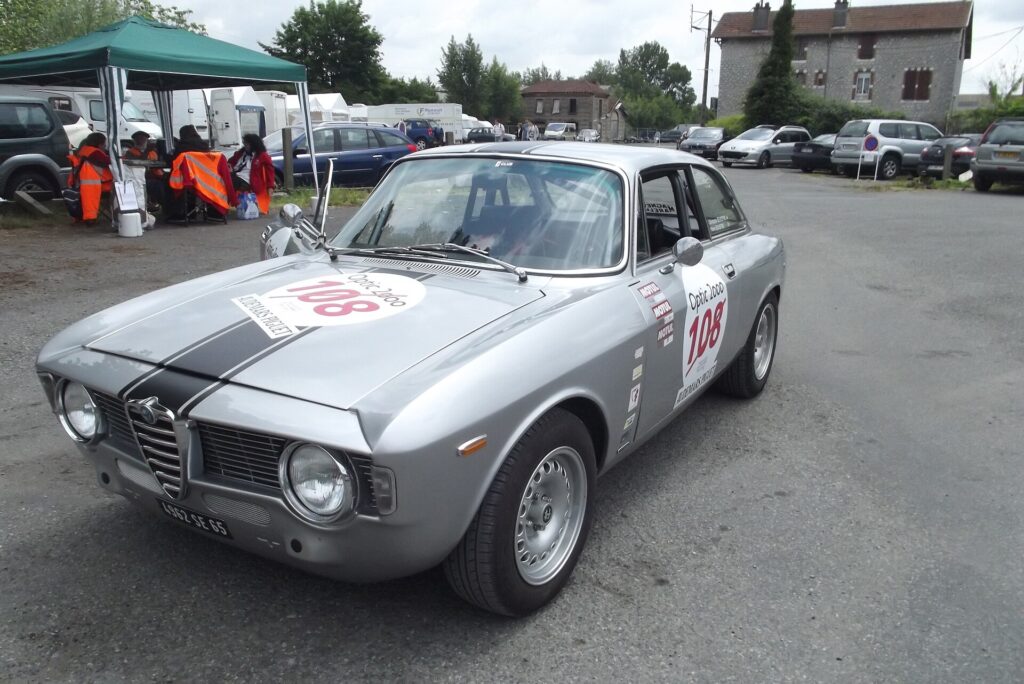
Giulia Sprint GT at a historic race in Pau.
Photo: Handelsgeselschaft / Wikimedia Commons, CC BY-SA 4.0
The family grows
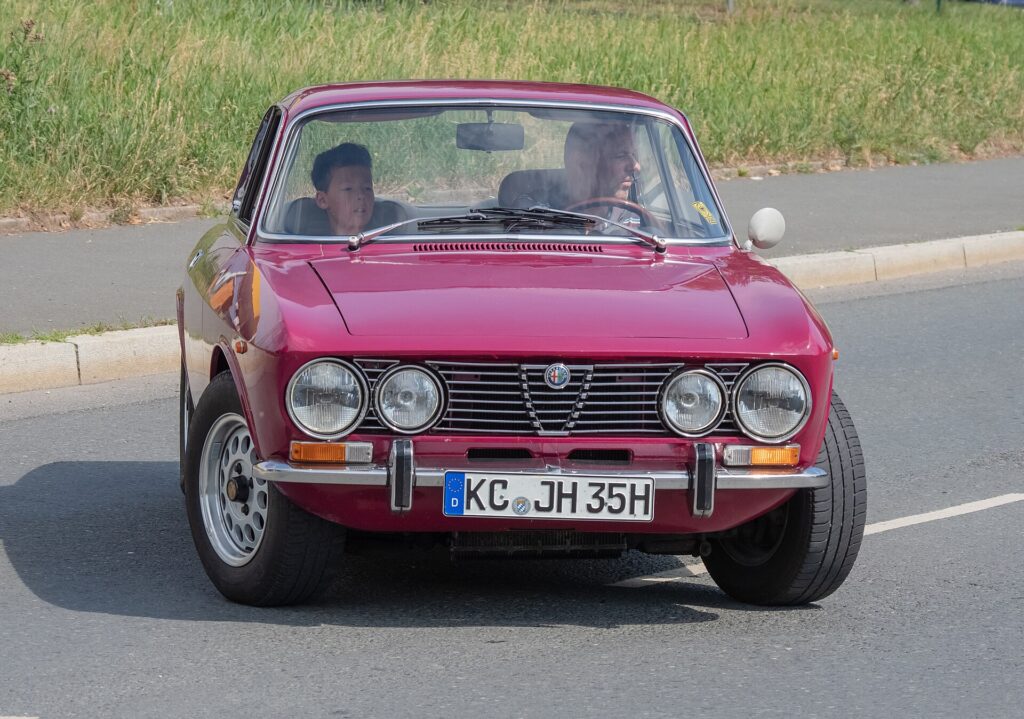
The Giulia Sprint GT (21,902 built up to 1965) spawned a whole range. The Sprint GT Veloce in 1966, the 1750 GTV in 1967 with four headlamps and no step, and the 2000 GTV in the early ’70s. Alongside them were the GT Junior models with 1,300 and 1,600 engines, for buyers who wanted the same car with less tax, something that in Italy and in Greece, with tax based on engine size, made a big difference. The series ended in 1977.
Alfa Romeo 2000 GTV of 1974: four headlamps and no step.
Photo: Ermell / Wikimedia Commons, CC BY-SA 4.0
GTA: the light one
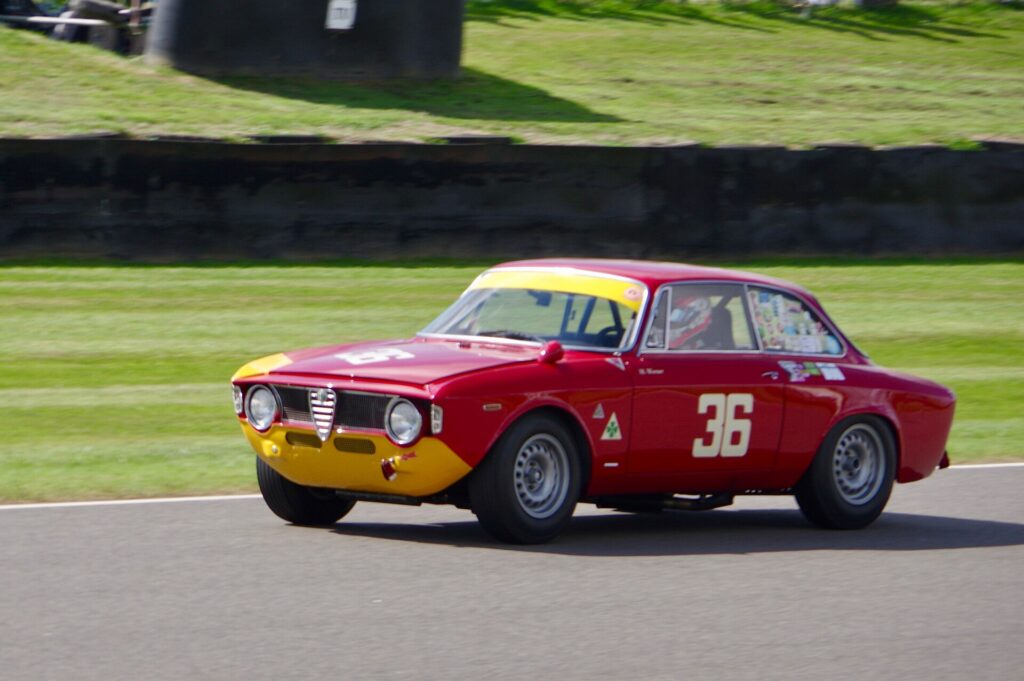
There is one version that for many is the holy grail. The 1965 Giulia Sprint GTA. The “A” stands for Alleggerita, “lightened”. From the outside it looks almost identical, but the body panels are aluminium, the engine has a twin-plug cylinder head and bigger Weber 45s, and many parts are made of light alloys. Almost every GTA went straight into racing, where they won a great deal, mostly in touring car championships. Today genuine ones cost as much as a house, and there are plenty of “GTAs” that started life as ordinary GTs.
A 1965 Giulia Sprint GTA in racing trim.
Photo: Dave Hamster / Wikimedia Commons, CC BY 2.0
Buying one: rust is the villain again
Italian cars of the period had little rust protection, and the 105s are no exception. Check the sills, floors, wheel arches, the bottoms of the wings, the boot and the base of the windscreen. Mechanically they are tougher than their reputation, as long as they’ve been maintained: the twin cam needs the right oil, adjusted valves and synchronised carburettors, and the gearbox often “crunches” into second when cold, something owners know about and forgive.
For me, the Giulia GT is proof that a car doesn’t need twelve cylinders to make you smile. It needs the right proportions, an engine that wants to rev and a steering wheel that talks to you. Alfa had all of that in 1963.
P.Kefalas
Photo Credits: Alexander Migl (Wikimedia Commons, CC BY-SA 4.0) · Dave Hamster (Wikimedia Commons, CC BY 2.0) · Ermell (Wikimedia Commons, CC BY-SA 4.0) · Handelsgeselschaft (Wikimedia Commons, CC BY-SA 4.0)