Citroën DS: The ‘Goddess’ That Fell From the Sky in 1955 Paris
on
There are cars you admire. And there are cars that, the first time you see them, you simply don’t understand what you’re looking at. The Citroën DS belongs to the second group. Remember that it appeared in 1955, when most Europeans were still driving cars that looked like trunks on wheels. And suddenly, at the Paris Motor Show, under the lights, sits something low, long, shaped like a drop of water, with no radiator grille, that raises itself up when it starts.
The name was no accident. In French, “DS” is pronounced exactly like the word déesse, meaning “goddess”. The French are never modest about their cars, but this time they were right.
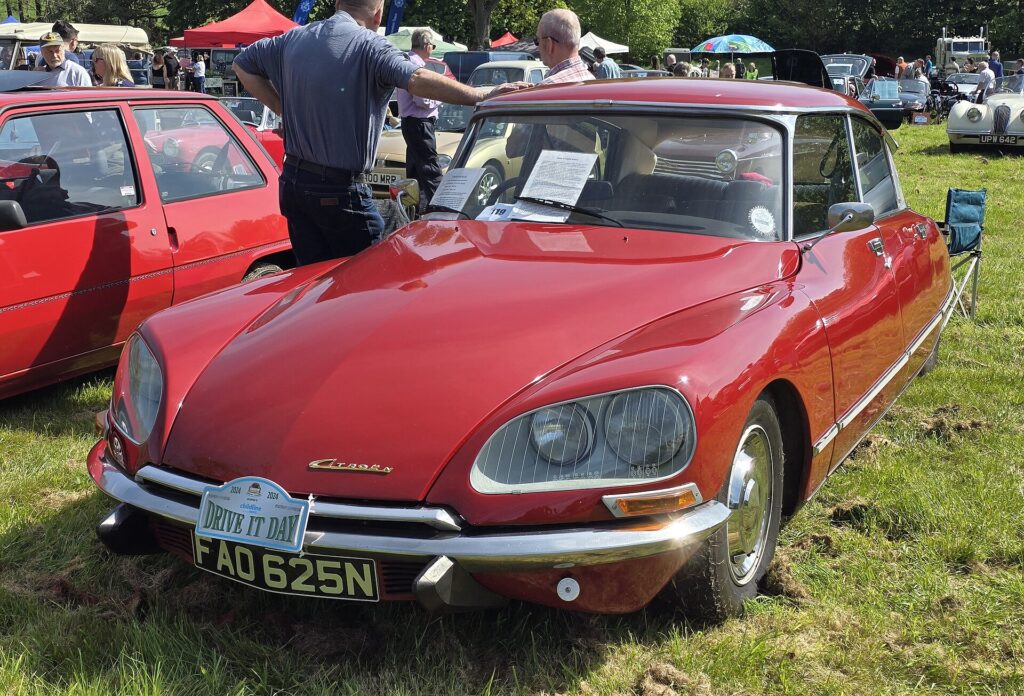
A 1975 Citroën DS 23 Pallas, from the last years of production.
Photo: Calreyn88 / Wikimedia Commons, CC BY-SA 4.0
The first day that changed everything
On 6 October 1955 the DS 19 was shown to the public. Within the first fifteen minutes Citroën had taken 743 orders. By the evening there were 12,000. Over the ten days of the show, deposits reached around 80,000, a record that stood for more than sixty years. To put it simply: people were paying money for a car they had never driven, just because they had seen it.
Behind the Goddess were three men worth remembering. The Italian sculptor Flaminio Bertoni, who gave it its shape. The aeronautical engineer André Lefèbvre, who thought of it as an aircraft without wings. And Paul Magès, a man without an engineering degree, who developed the hydropneumatic suspension inside Citroën. Bertoni was a sculptor and it shows. The DS wasn’t designed with a ruler.
Suspension from another planet
Here is the essence of the car. Instead of conventional springs, the DS had spheres containing nitrogen and fluid under pressure. An engine-driven pump kept the whole system at around 170 bar, and the same hydraulic circuit worked the brakes, the steering, the clutch and the gear change. The result? The car always kept the same height, empty or loaded, and rode over the broken French roads of the time as if on a cushion. Journalists called it a “magic carpet” and they weren’t exaggerating.
From the dashboard you could raise or lower the body. If you had a puncture, you raised the car to its highest position, put in a stand, lowered the suspension and the wheel lifted itself off the ground. No jack. In 1955.
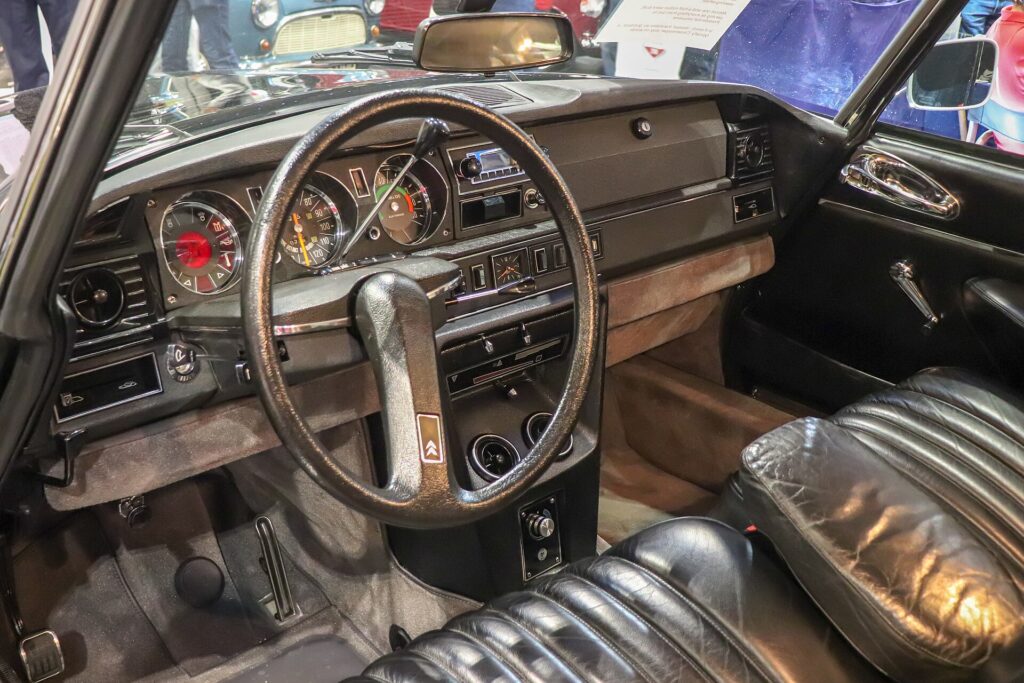
Inside a DS 21: the single-spoke steering wheel became a trademark.
Photo: Vauxford / Wikimedia Commons, CC BY-SA 4.0
It was also the first mass-production car to use disc brakes successfully, at the front, mounted inboard next to the gearbox to reduce weight at the wheels. And in 1967, with the Series 3 styled by Robert Opron, came the swivelling headlamps: the inner lamps behind the glass cover turned with the steering, so you could see into the bend. Something we pay extra for on new cars today.
The general and the bullets
If you want one story to understand what this suspension could do, it’s this. On 22 August 1962, at Petit-Clamart outside Paris, President Charles de Gaulle was ambushed by the OAS. His black DS was riddled with bullets and two tyres were shot out. The driver floored it and the car got away and held the road thanks to its suspension. De Gaulle came out unhurt and, so it’s said, from then on wouldn’t hear of any other car.
The Goddess wasn’t just for show in competition either. It won the Monte Carlo Rally in 1959 and again in 1966, and in 1974 it took victory in the gruelling London–Sahara–Munich rally, where out of around seventy starters only a handful reached the finish.
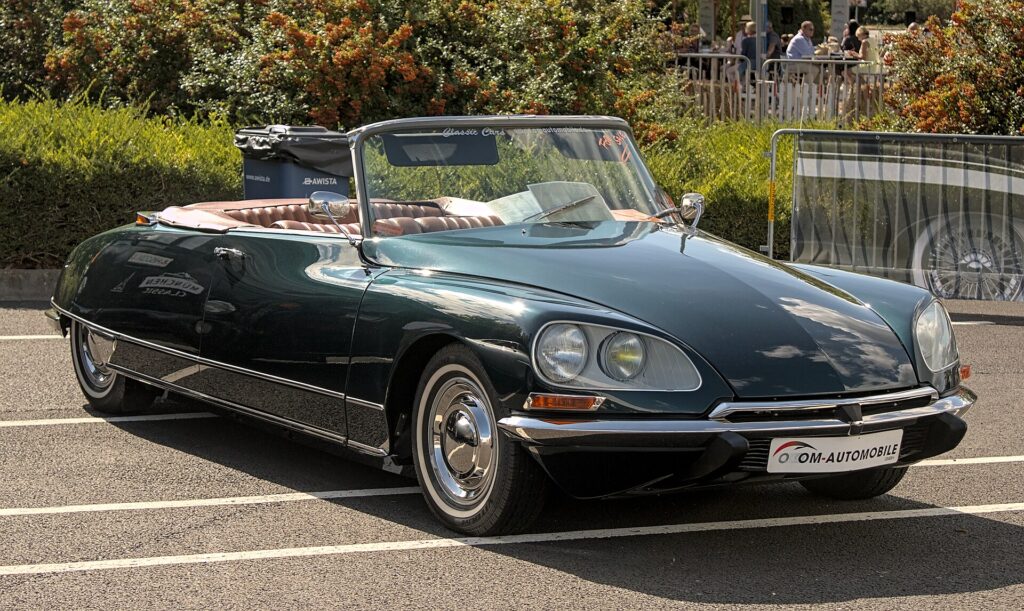
A DS Cabriolet by Henri Chapron, the most elegant member of the family.
Photo: Alexander Migl / Wikimedia Commons, CC BY-SA 4.0
What you need to know if the bug bites
The DS was built from 1955 until 24 April 1975, and 1,455,746 were made in total, including the cheaper ID, the estates (Break, Familiale) and the beautiful Henri Chapron convertibles. So it isn’t a rare car. But it is a car that needs an owner who knows what they’re doing.
The first thing I look at on a DS is the fluid. Up to 1967 the cars used LHS fluid (with parts painted black), then they switched to green mineral LHM, which is why Citroën painted all the hydraulic parts green. Put in the wrong fluid and the seals melt. Second, rust: the body sits on a platform that rots out of sight, especially in the sills and the mounting points. Third, the suspension spheres need renewing, or the magic carpet turns into a plank.
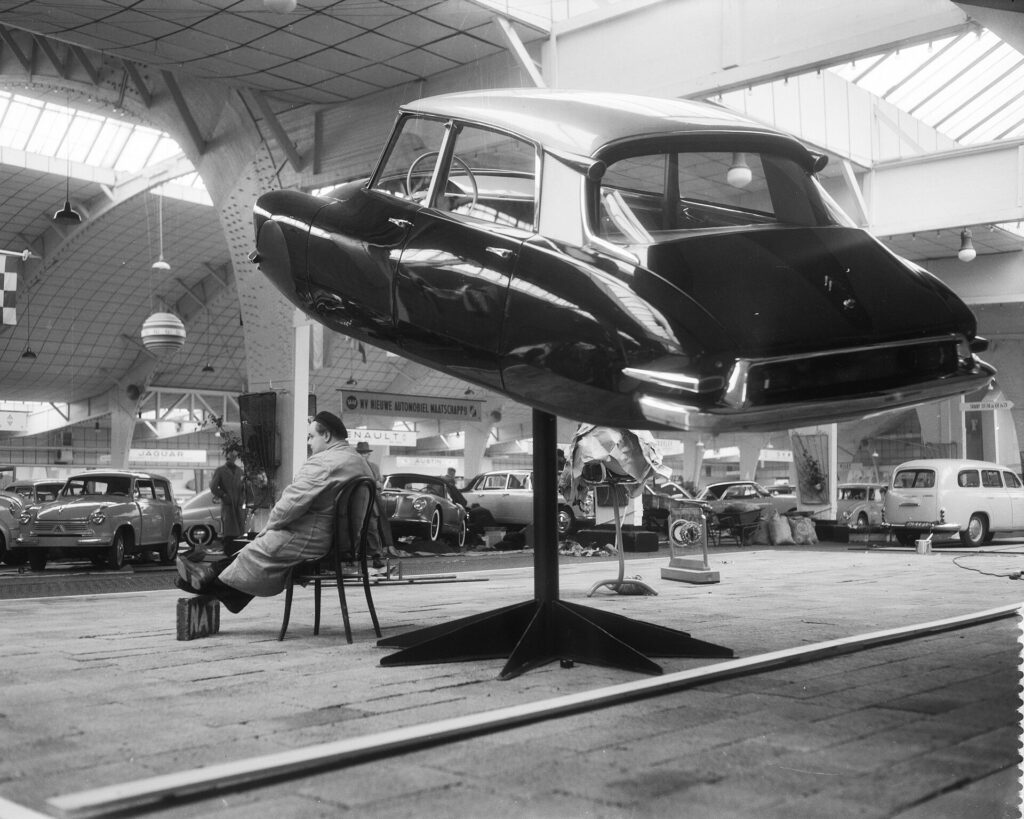
A DS19 ‘in the air’ at the RAI motor show in Amsterdam, in the 1950s.
Photo: Harry Pot / Anefo / Wikimedia Commons, CC0
Roland Barthes wrote that the DS looks as if it had “fallen from the sky”. Seventy years later, when one passes me on the road, that’s still how I see it. And I still turn my head.
P.Kefalas
Photo Credits: Calreyn88 (Wikimedia Commons, CC BY-SA 4.0) · Vauxford (Wikimedia Commons, CC BY-SA 4.0) · Alexander Migl (Wikimedia Commons, CC BY-SA 4.0) · Harry Pot / Anefo (Wikimedia Commons, CC0)