
Before the Miura, the fastest road cars had their engines at the front. Race cars had started putting them in the middle, behind the driver, but nobody had dared do it in a luxury road car. Lamborghini did it in 1966, and the car world was never the same again. Many say the word “supercar” was born with the Miura.
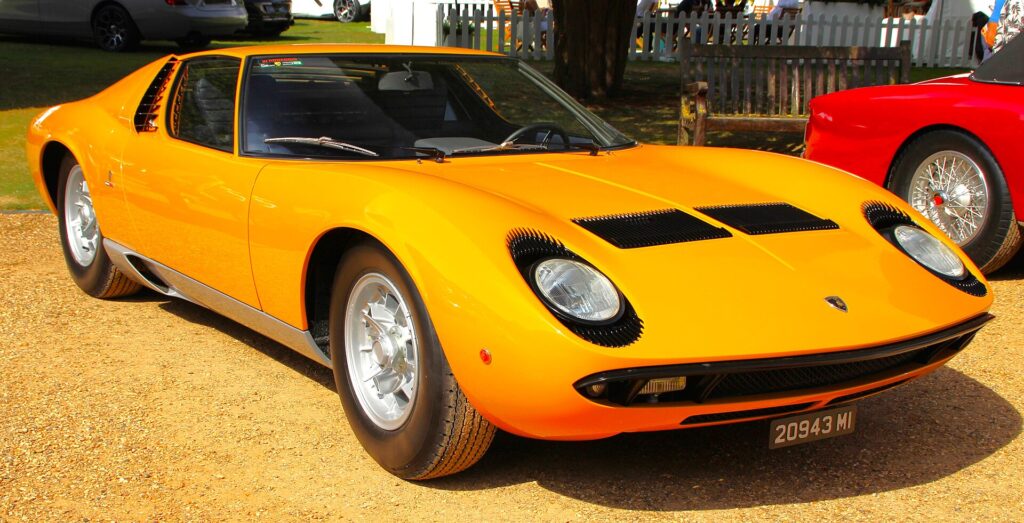
Photo: MrWalkr / Wikimedia Commons, CC BY-SA 4.0
A chassis built in the evenings
The Miura began almost in secret. Three young Lamborghini people, engineer Gian Paolo Dallara, his colleague Paolo Stanzani and New Zealand test driver Bob Wallace, worked in their spare time on a mid-engined chassis. Ferruccio Lamborghini mainly wanted quiet, comfortable GTs, not racers. But they convinced him such a car would be the best advertising for his new company.
The bare chassis, with no body, was shown at the 1965 Turin Motor Show. Even without a body, customers left deposits. For the body Lamborghini went to Bertone, where 27-year-old Marcello Gandini designed one of the most beautiful cars of all time.
The sideways V12
To fit the big 3.9-litre V12 in the middle without making the car enormous, the engineers mounted it transversely, with the gearbox built in underneath, sharing the same sump. It was a solution reminiscent of the Mini, but in a car with 350 horsepower. The Miura P400 was unveiled in Geneva in 1966 and caused a sensation.
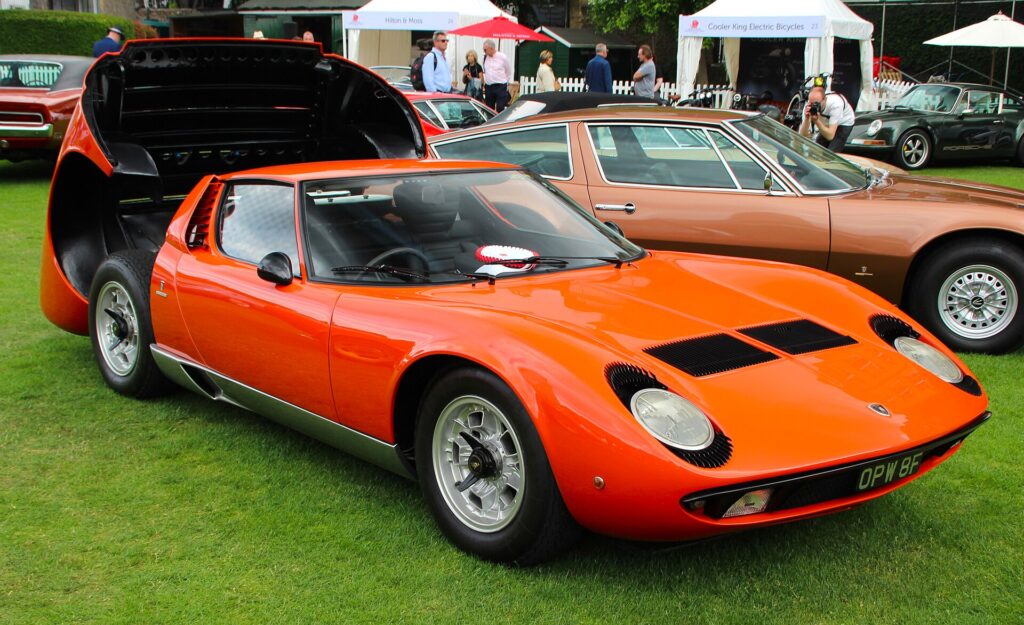
Photo: MrWalkr / Wikimedia Commons, CC BY-SA 4.0
The name was chosen by Ferruccio himself, a Taurus by star sign and a lover of bullfighting. Miura was the name of a famous Spanish breeder of fighting bulls. Since then almost every Lamborghini has been named after a bull or something from bullfighting.
P400, S and SV
The first Miura had weaknesses. At high speed the nose went light, and engine heat reached the cabin. Lamborghini improved it constantly. In 1969 came the P400 S, with a little more power and a better interior. In 1971 the P400 SV, with 385 horsepower, wider rear wheels and without the distinctive “eyelashes” around the headlights. The SV is considered the most complete Miura.
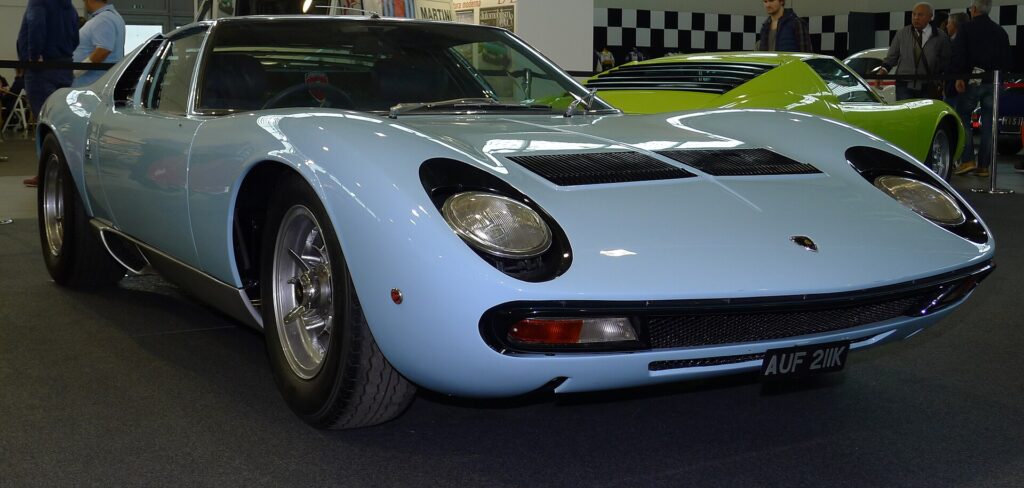
Photo: Vllmtt / Wikimedia Commons, CC BY-SA 4.0
The end and the legend
Production stopped in 1973, after about 760 cars, to make way for the Countach. The Miura also became a film star: at the start of the 1969 film “The Italian Job”, an orange Miura climbs the hairpins of the Alps to music, in one of the most beautiful car scenes ever filmed.
Today the Miura is one of the most expensive classic cars, and every mid-engined supercar, from Ferrari to McLaren, owes it something. It was the first to dare.
P.Kefalas