
In 1936 America was still in the Great Depression. Of the dozens of motorcycle makers from the early years of the century, only two serious ones were left: Harley-Davidson and Indian. And Harley, instead of cutting back, took a huge risk. It designed a completely new engine. American riders called it the Knucklehead, and that engine defined the image of Harley for the next ninety years.
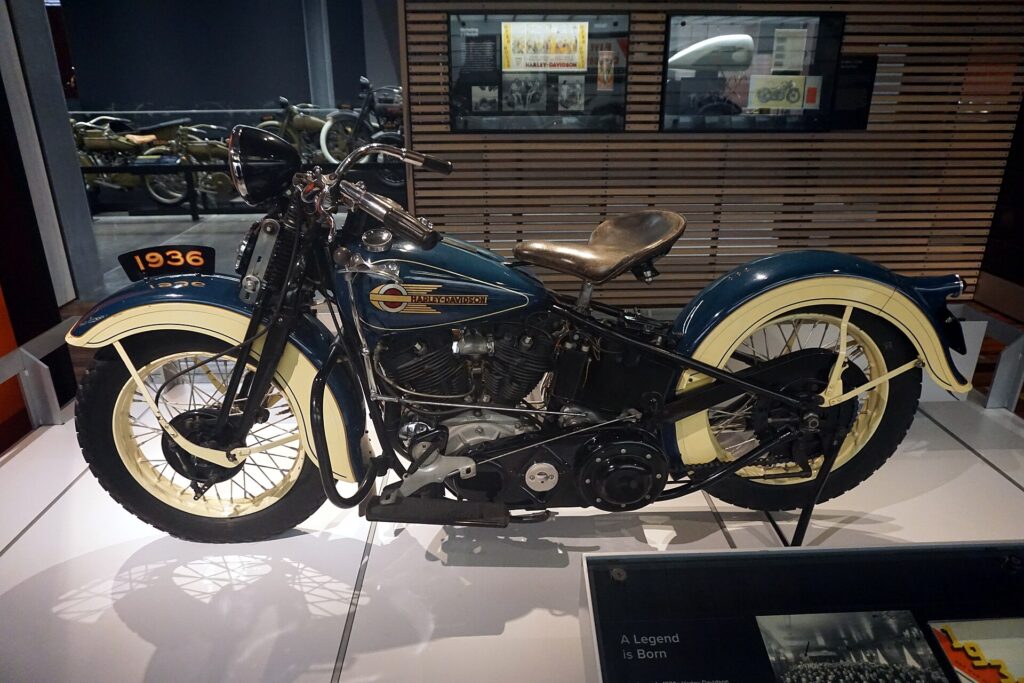
Photo: Michael Barera / Wikimedia Commons, CC BY-SA 4.0
Why “Knucklehead”
Harley never called it that. The official names were “Model E” and “EL” for the higher-performance version. But look at the engine from the side and the rocker covers on top of the heads, with their round bolts, look like the knuckles of a clenched fist. The name stuck, and since then every Harley engine has had a nickname: Panhead, Shovelhead, Evolution.
What was new
Until then Harley’s big V-twins had side valves (flathead), a simple but not very efficient design. The Knucklehead had overhead valves (OHV), which gave it much more power from the same capacity. Its 61 cubic inches (about 1,000 cc) produced around 40 hp in EL form, almost double the old flatheads of the same size.
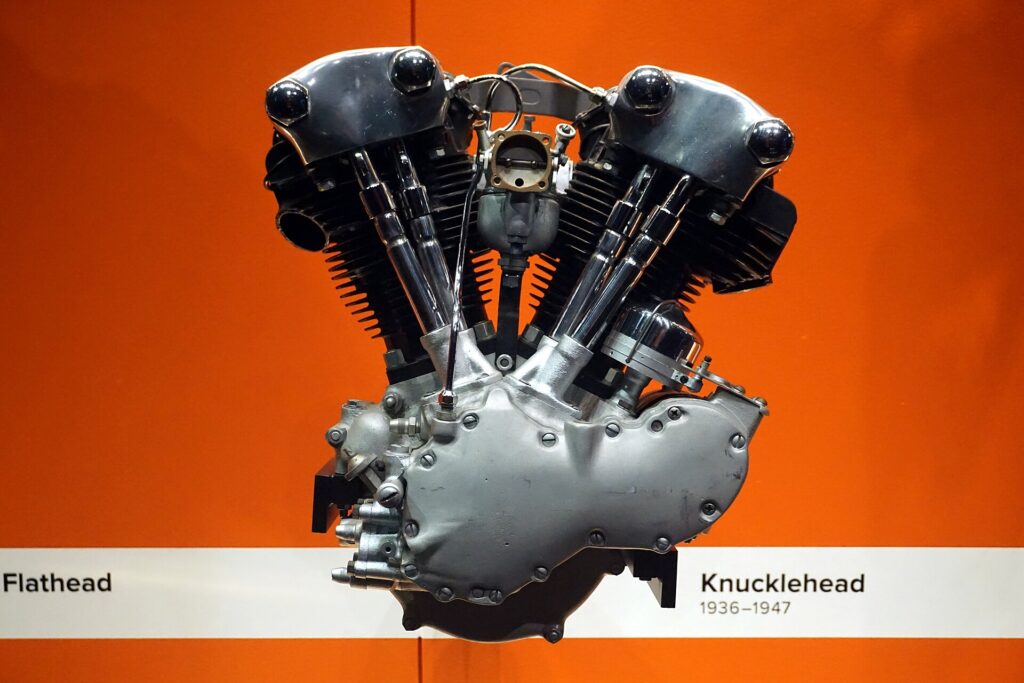
Photo: Michael Barera / Wikimedia Commons, CC BY-SA 4.0
It also had a recirculating oil system, whereas earlier models slowly burned their oil away. A four-speed gearbox, teardrop tanks with the instruments mounted on top (the famous “tombstone” speedometer) and a silhouette that, if you see it today, you instantly recognise as a Harley. In 1941 came the 74 cubic inch (1,200 cc) version, the FL.
Joe Petrali’s record
To prove what the new engine could do, in 1937 Harley sent racer Joe Petrali to the beach at Daytona, Florida, with a specially prepared EL. Petrali reached 136.183 mph and made Harley the holder of the American speed record. For a company that until then had been seen as “slow but reliable”, it was enormous publicity.
After the war: bobbers and choppers
Knucklehead production lasted until 1947, when the Panhead replaced it. Its real fame, however, came afterwards. American servicemen returning from the war bought second-hand Knuckleheads, stripped off everything unnecessary (fenders, lights, bags), shortened the rear fender and made them lighter and faster. That is how “bobbers” were born, and from them, a generation later, “choppers”.
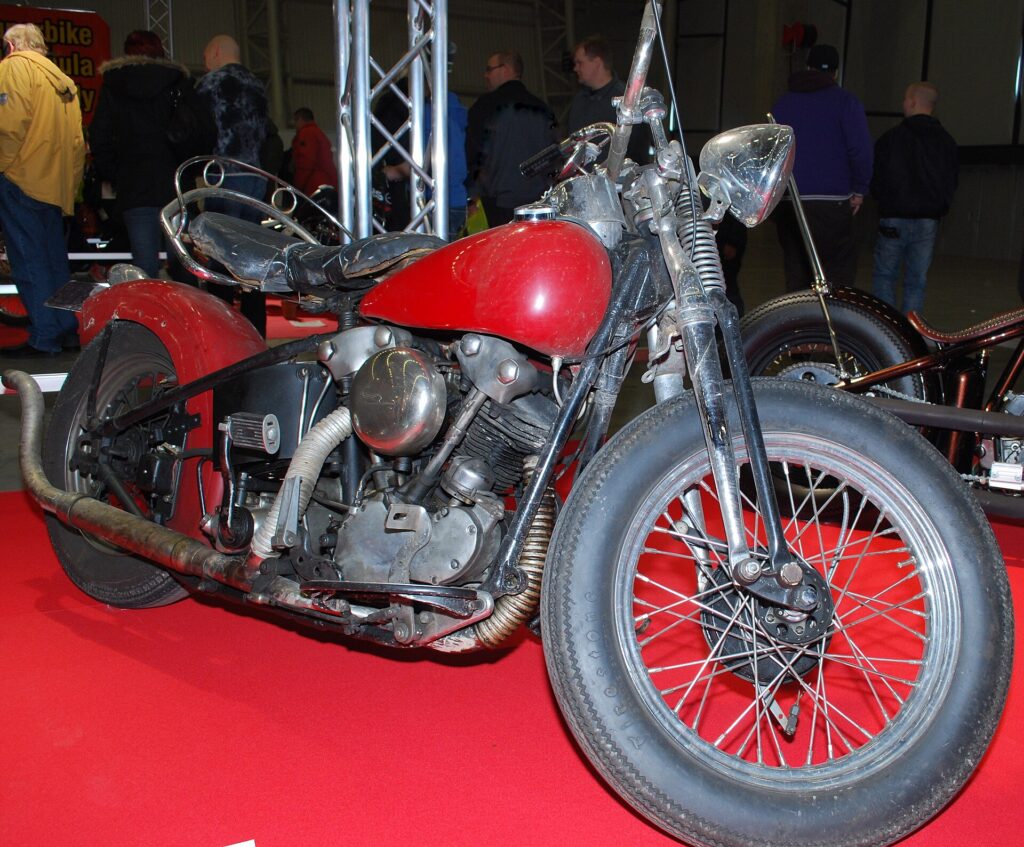
Photo: Dave_S. from Witney, England / Wikimedia Commons, CC BY 2.0
The Knucklehead today
Original Knuckleheads are now among the most valuable American classic motorcycles, and 1936 models are especially prized because it was the first year and had several details that changed later. Many reproduction engines and parts exist, which is good news for people who want to ride, but makes life hard for anyone looking for an original. If you ever find one, ask for its history, check the engine numbers (they start with the year, for example “36EL”) and, if you can, take someone who knows these bikes with you.
P.Kefalas
Photo Credits: Michael Barera (Wikimedia Commons, CC BY-SA 4.0) · Michael Barera (Wikimedia Commons, CC BY-SA 4.0) · Dave_S. from Witney, England (Wikimedia Commons, CC BY 2.0)