Lancia Stratos: The First Car Built Purely to Win Rallies
on
On this site I’ve written about the Fulvia HF Fanalone and the Delta Integrale. But between them there’s a car that for me is the craziest thing Lancia ever produced, and perhaps the Italian car industry in general. The Stratos. A car that didn’t start as a road car to become a racer. It started the other way round. It was a racing car from the first line on paper, and Lancia built as many “road” versions as it needed only so it would be allowed to race.
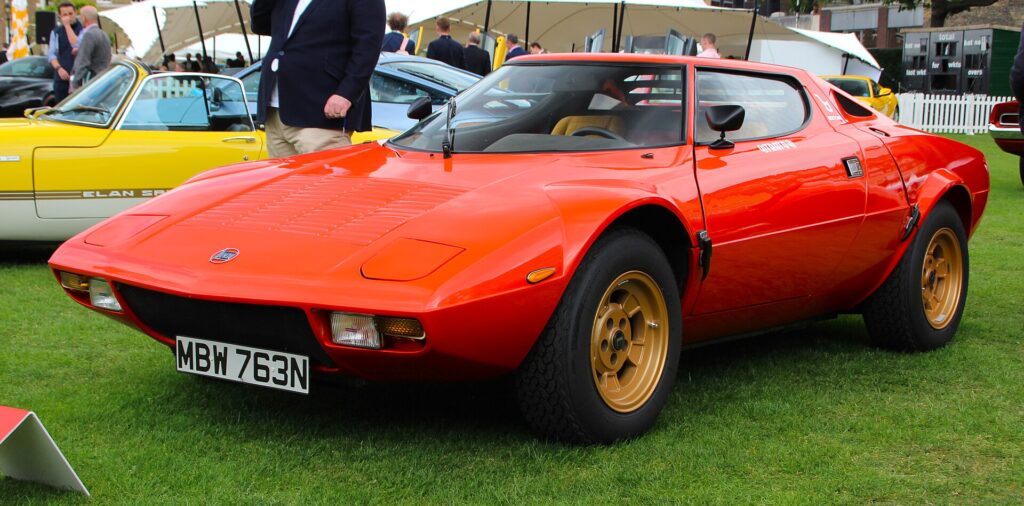
A 1975 Lancia Stratos HF Stradale.
Photo: MrWalkr / Wikimedia Commons, CC BY-SA 4.0
An orange wedge under the barrier
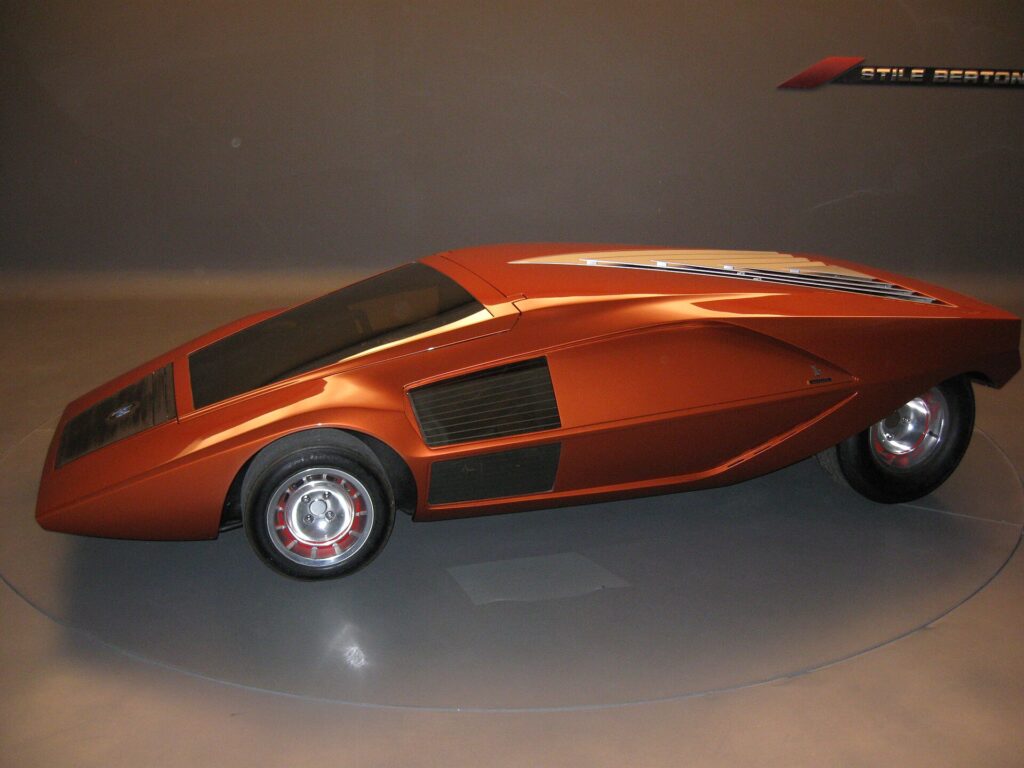
The story starts at Bertone. Lancia traditionally worked with Pininfarina, and Nuccio Bertone wanted, at any cost, to get his foot in the door. He knew Lancia was looking for a successor to the ageing Fulvia in rallying. So, at the 1970 Turin Motor Show, he presented the Stratos Zero, a prototype designed by Marcello Gandini, the same man who had done the Miura and later the Countach. It was an orange wedge only 84 centimetres tall, with no doors. You got in by opening the windscreen.
It’s said that Bertone drove the Zero to the gates of Lancia, passed under the guardhouse barrier without it being raised, and the workers came out to applaud. Like all good stories, it may be a little seasoned. The result, though, is well known: Lancia asked Bertone to build the real car.
The 1970 Lancia Stratos Zero, designed by Marcello Gandini for Bertone.
Photo: LarryStevens / Wikimedia Commons, CC0
Ferrari engine, go-kart wheelbase
The Stratos HF prototype appeared in Turin in 1971. Its shape had a lot of the Miura in it, with two big clamshell covers opening front and rear, but the key was the dimensions. A wheelbase of just 2.18 metres, very wide tracks, engine in the middle behind the driver. A car that spun around itself like a top. Drivers said that on the straight it needed constant correction, and that if you didn’t know what you were doing, it would put you off the road before you had time to think.
For the engine, Lancia, by then part of the Fiat group, took the 2.4-litre V6 from the Ferrari Dino. Enzo Ferrari wasn’t thrilled at the idea of giving his engine to a rival, but in the end he did. In competition form the Stratos made around 275 hp with the 12-valve heads and up to 320 with the 24-valve ones, in a car weighing under a tonne.
To enter Group 4, the rules required 500 production cars. Production started in 1973, and the Stratos was homologated for the 1974 season. Whether all 500 were really built is one of the eternal debates among enthusiasts. The road cars, anyway, sold slowly. Who wanted a car with zero rear visibility and a supercar price?
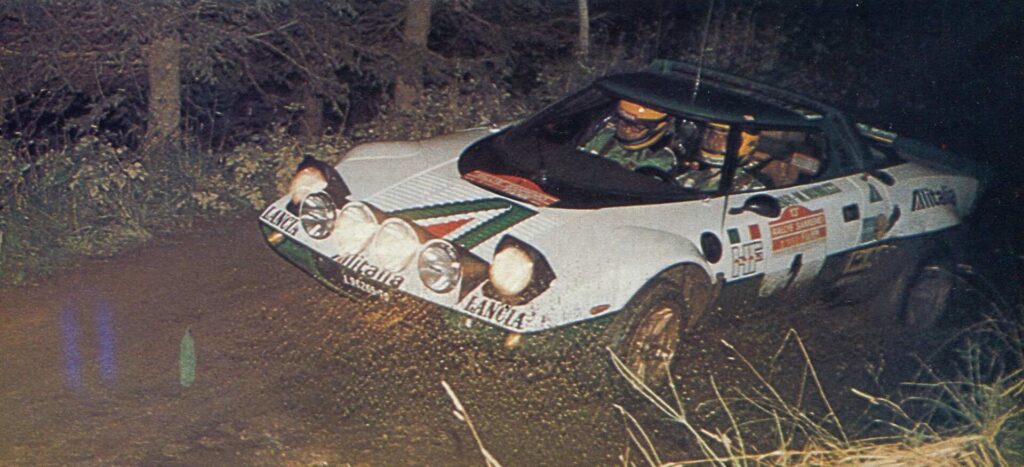
Sandro Munari in the Alitalia Stratos at the 1975 Sanremo Rally.
Photo: BIASIOLI Photo / Wikimedia Commons, Public domain
Alitalia, Munari and three championships
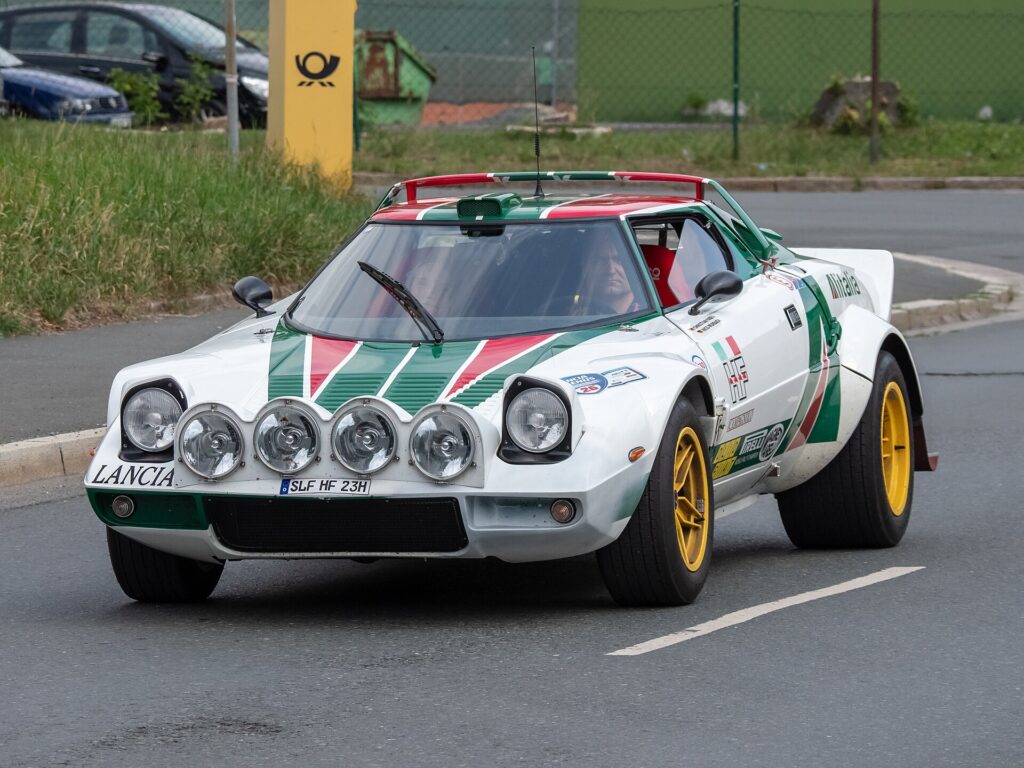
In the white, green and red colours of Alitalia, the Stratos became the image of ’70s rallying. It won the World Rally Championship in 1974, 1975 and 1976. Sandro Munari, “the Dragon”, won the Monte Carlo with it three times in a row (1975, 1976, 1977), while drivers such as Björn Waldegård shared the victories. The Stratos also won the Targa Florio in 1974 and the Tour de France Automobile five times.
And then politics got in the way. The Fiat group decided that rallying only sells cars if the winning car looks like the one people buy. So official support passed to the Fiat 131 Abarth, and the Stratos was left to privateers. The strange thing is that it kept winning. Its last World Championship victory came in 1981, on the Tour de Corse, with Bernard Darniche, almost ten years after the first prototype.
A Stratos HF in Alitalia colours at a classic car meeting.
Photo: Ermell / Wikimedia Commons, CC BY-SA 4.0
The legacy
After the Stratos nothing was the same in rallying. The Audi Quattro, Group B, the Delta S4 and the 037 all build on an idea the Stratos proved first: that you can design a car specifically to win, and sell it afterwards. Today a genuine Stratos Stradale is one of the most expensive Italian cars of its era, and there are many replicas too. If someone offers you one, ask for history and specialist certification. Genuine ones are few.
For me, the Stratos is the car that made rallying look like science fiction. And every time I see a photo of one with its lights blazing in the night, I think I can hear the V6 screaming through the hairpins above Monaco.
P.Kefalas
Photo Credits: MrWalkr (Wikimedia Commons, CC BY-SA 4.0) · LarryStevens (Wikimedia Commons, CC0) · BIASIOLI Photo (Wikimedia Commons, Public domain) · Ermell (Wikimedia Commons, CC BY-SA 4.0)