
In 1948 Europe was still clearing the rubble of war. Petrol was rationed, most cars were pre-war designs, and a small factory in Stevenage, England, unveiled a motorcycle that could reach 125 mph. Nothing on the road, on two wheels or four, came close. It was called the Vincent Black Shadow.
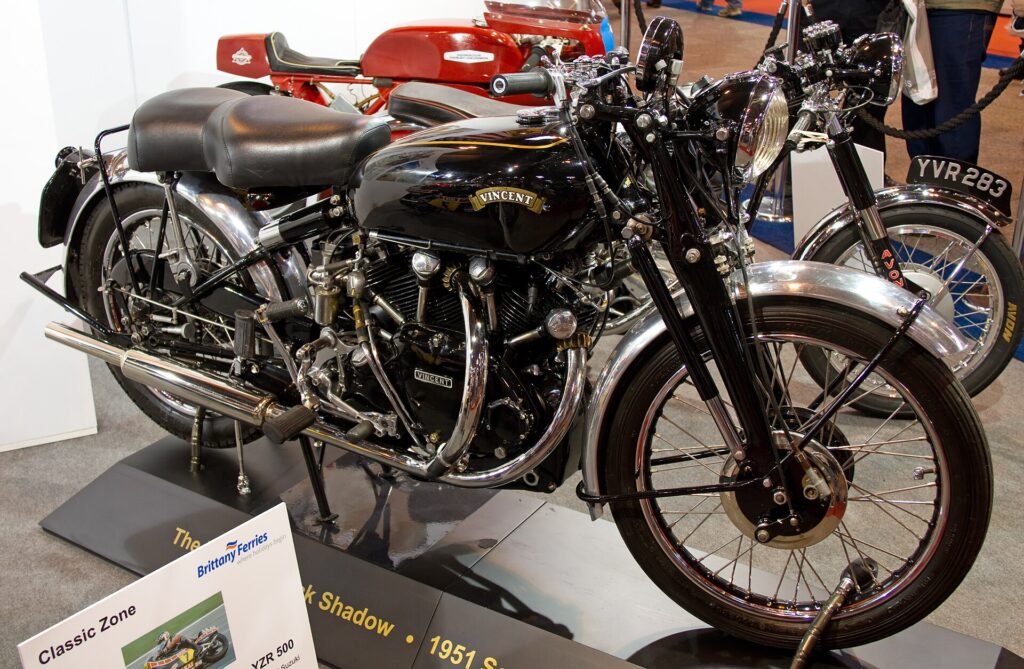
Photo: Tony Hisgett from Birmingham, UK / Wikimedia Commons, CC BY 2.0
Two engineers and a drawing
Philip Vincent was the son of a wealthy Argentine cattle rancher. He studied engineering at Cambridge and in 1928 bought the name of HRD, a small company that had gone bust. A few years later he was joined by Phil Irving, a gifted Australian engineer. According to legend, Irving saw two drawings of their single-cylinder engine lying on top of each other at an angle and saw a V-twin. The result was the first Rapide of 1936.
After the war the engine was redesigned from scratch: 998 cc, a 50-degree V-twin, with engine and gearbox in one unit. The Series B Rapide was already very fast. But Vincent and Irving wanted more.
Black Shadow: black, fast and different
The Black Shadow was a Rapide with hand-picked engines: polished internals, larger carburettors and higher compression. It made about 55 hp and could reach 125 mph. To set it apart, the engine was finished in black enamel, which also helped cooling. The speedometer, a huge round Smiths instrument, read up to 150 mph, a number that looked crazy in 1948.
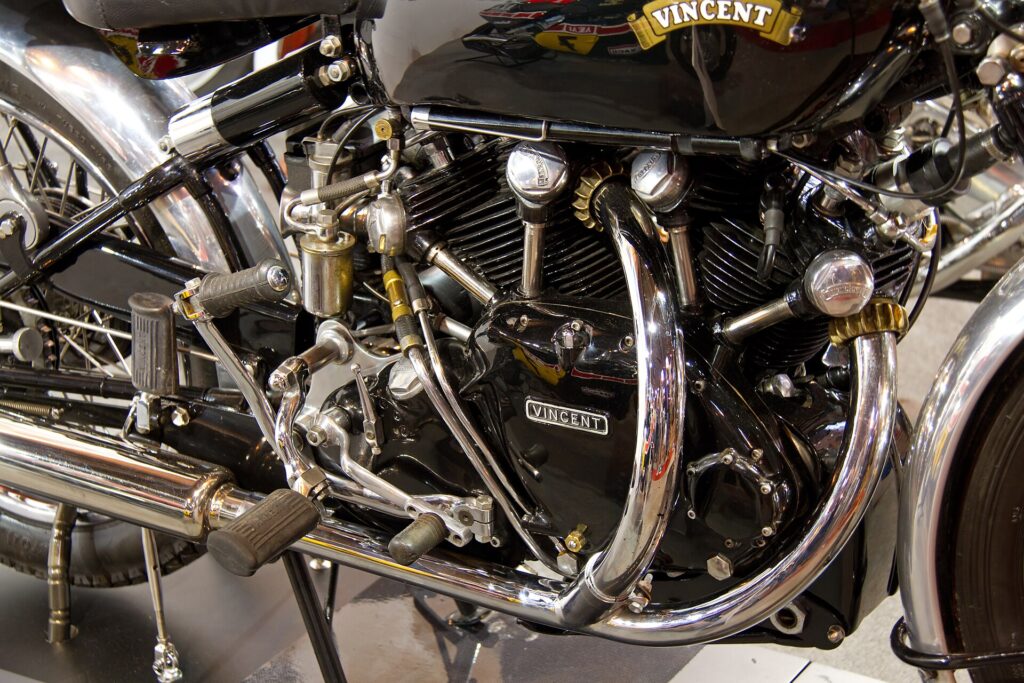
Photo: Tony Hisgett from Birmingham, UK / Wikimedia Commons, CC BY 2.0
The cleverest part, though, was what you could not see. The Vincent had no conventional frame. The engine itself was a stressed member, and above it ran a hollow steel spine that doubled as the oil tank. The rear suspension used a triangulated swinging arm with springs under the seat, an early form of the monoshock layout that became common decades later. It was lighter, stiffer and shorter than its rivals.
The man in the swimsuit
In September 1948, on the Bonneville salt flats in Utah, American rider Rollie Free climbed onto a specially prepared Vincent to break the US speed record. On the first run his leathers tore and slowed him down. So he took them off, put on just a pair of swimming trunks, a cap and canvas shoes, and lay flat on the bike with his legs stretched out behind. He reached 150.313 mph.
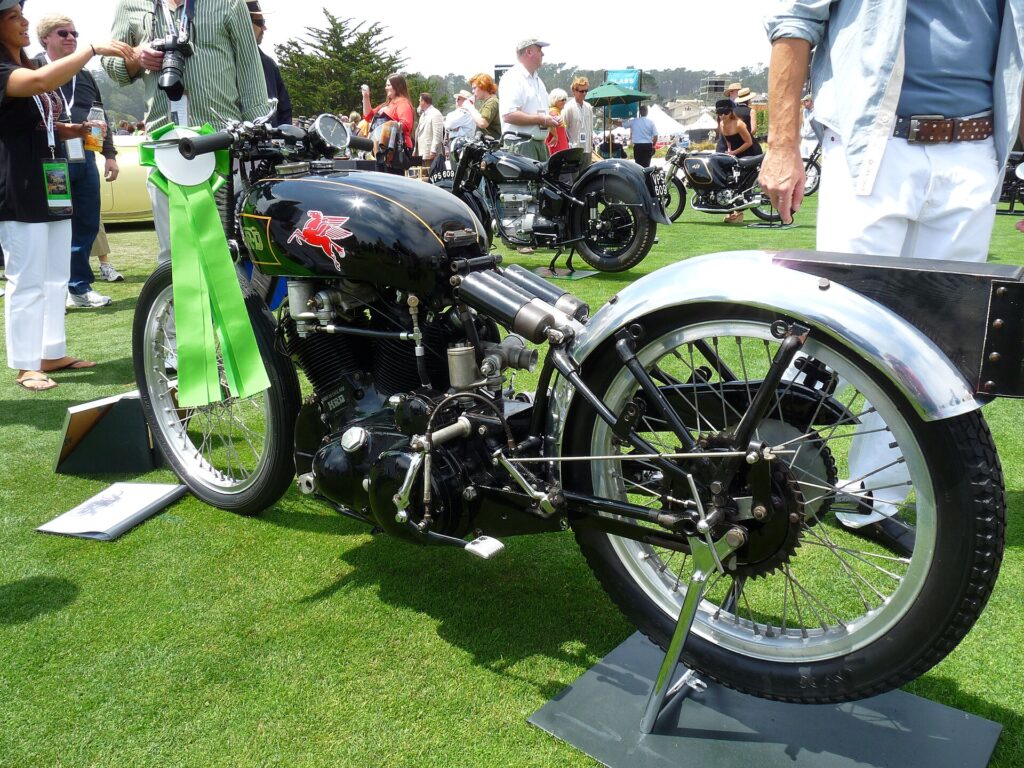
Photo: Craig Howell from San Carlos, CA, USA / Wikimedia Commons, CC BY 2.0
The photograph of him lying on the Vincent in his trunks became one of the most famous images in motorcycling history, and it turned the Black Shadow into a symbol of speed around the world.
The end and the legend
Sadly, brilliant engineering does not always mean profit. Vincents were very expensive to build, the post-war market wanted cheap transport, and in 1955 production stopped. About 1,700 Black Shadows had been made.
Today a genuine Black Shadow is one of the most sought-after classic motorcycles, and a good engine with matching numbers is worth a small fortune on its own. If you ever hear one start, you will understand why it sounds like nothing else: deep, slow and heavy, like something very large that has just woken up.
P.Kefalas
Photo Credits: Tony Hisgett from Birmingham, UK (Wikimedia Commons, CC BY 2.0) · Tony Hisgett from Birmingham, UK (Wikimedia Commons, CC BY 2.0) · Craig Howell from San Carlos, CA, USA (Wikimedia Commons, CC BY 2.0)