
When Jaguar unveiled the E-Type at the Geneva Motor Show in March 1961, people literally crowded around it. It is said that even Enzo Ferrari, who rarely praised rivals, called it “the most beautiful car ever made”. Whether he said it or not, the phrase stuck, because many still agree today.
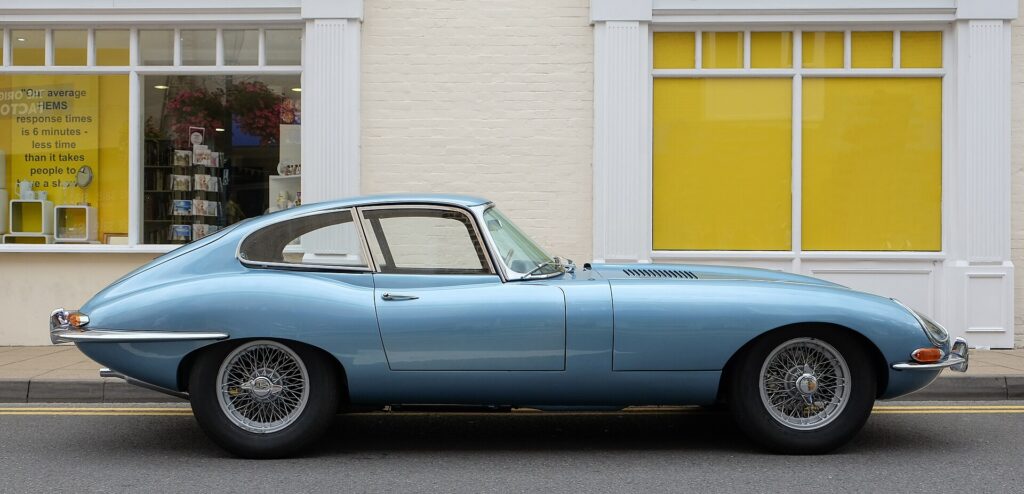
Photo: DeFacto / Wikimedia Commons, CC BY-SA 4.0
An aerodynamicist from aircraft
The E-Type was designed by Malcolm Sayer, an engineer who had worked in the Bristol aircraft industry. Sayer was not a stylist in the usual sense. He calculated the curves mathematically, so that the air would flow as smoothly as possible. He had already designed the C-Type and D-Type race cars, which won Le Mans five times in the 1950s. The E-Type was essentially a D-Type for the road.
The car had a monocoque cabin with a tubular front frame for the engine, independent rear suspension and disc brakes on all four wheels. For 1961, that was race-car technology.
A night drive to Geneva
The launch came with a story the British love. Demand for test drives was so great that Jaguar asked test driver Norman Dewis to bring a second car from Coventry. Dewis drove through the night and arrived in Geneva the next morning, ready for the journalists.
Jaguar claimed a top speed of 150 miles per hour, about 240 km/h, with the 3.8-litre XK six-cylinder engine. The test cars were probably slightly “tuned” to achieve it. But even standard cars were very fast, and they cost far less than a Ferrari or an Aston Martin.
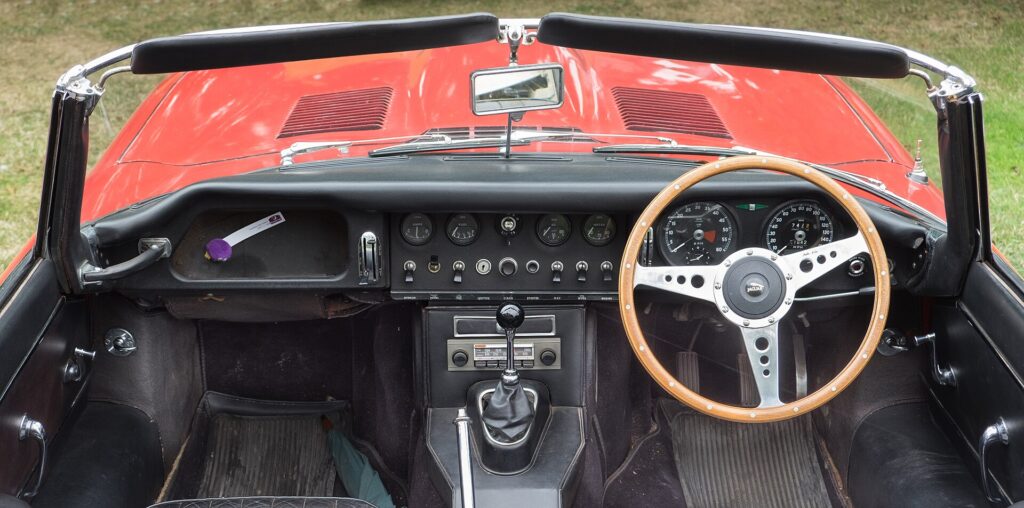
Photo: DeFacto / Wikimedia Commons, CC BY-SA 4.0
Three series
The Series 1 (1961–1968) is the purest and most sought after. From 1964 it got a 4.2-litre engine and a better gearbox. The Series 2 (1968–1971) changed to meet American rules, with uncovered headlights and bigger bumpers. The Series 3 (1971–1975) got a new 5.3-litre V12, wider wings and a bigger grille. It was more comfortable and more powerful, but lost some of the original delicacy.
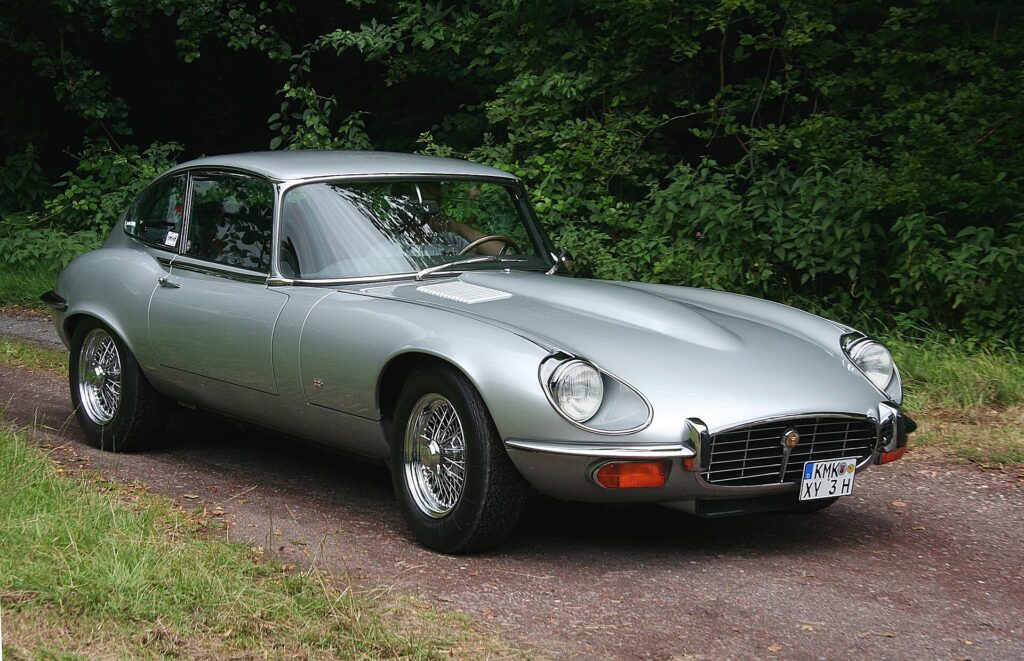
Photo: Lothar Spurzem / Wikimedia Commons, CC BY-SA 2.0 de
A work of art
By 1975 more than 70,000 E-Types had been built. In 1996 the Museum of Modern Art in New York, MoMA, added an E-Type roadster to its permanent collection as one of the most important examples of industrial design. It is one of very few cars to be honoured in this way.
Today the E-Type is one of the best-loved classics. If you are looking for one, check carefully for rust in the monocoque and underneath, because restoration is expensive. And know that wherever you park it, someone will stop to look.
P.Kefalas