
Most Italian sports motorcycles of the 1970s were born on the race track. The Moto Guzzi V7 Sport was born from an engine built for a military three-wheeler and for police motorcycles. Yet when it came out in 1971, it was one of the fastest and most stable motorcycles in the world. And it gave Moto Guzzi the character it still has today.
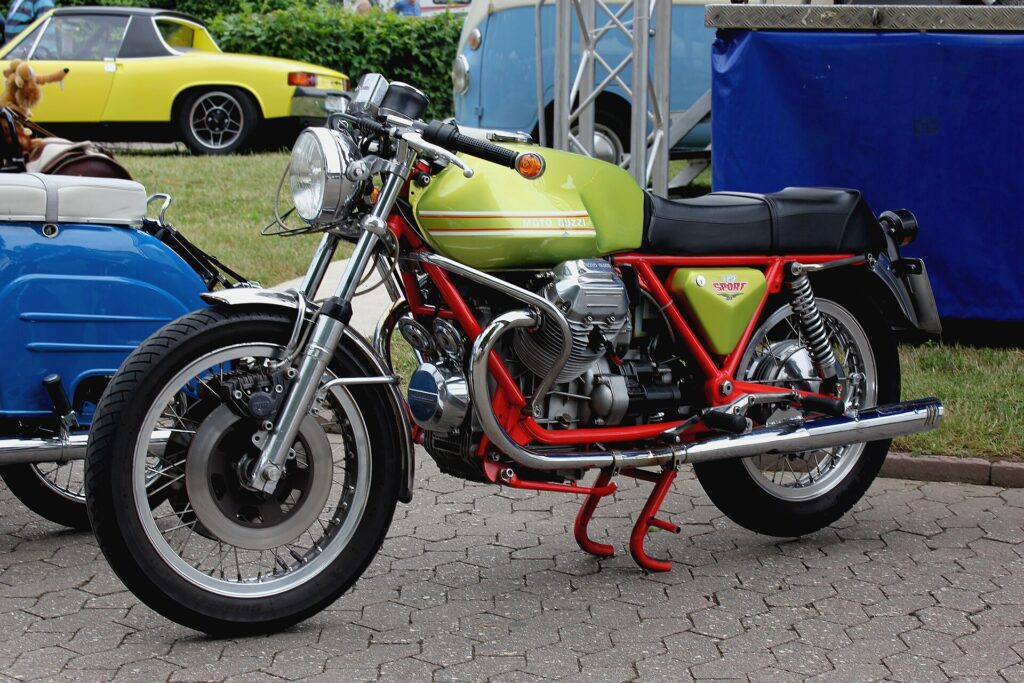
Photo: Lothar Spurzem / Wikimedia Commons, CC BY-SA 2.0 de
An eagle by the lake
Moto Guzzi was founded in 1921 in Mandello del Lario, a beautiful village on the shores of Lake Como. The founders were engineer Carlo Guzzi and his friend Giorgio Parodi, who had met in the Italian air force in the First World War. There was a third friend, the pilot Giovanni Ravelli, who was killed in a flying accident before the company started. In his honour, the Moto Guzzi badge is an eagle with spread wings.
For decades Moto Guzzi was known for its horizontal single-cylinder engines and for hugely successful racing motorcycles. The most famous was the incredible 500 cc V8 of the 1950s.
One engine for every job
In the 1960s engineer Giulio Cesare Carcano designed a 90-degree V-twin, mounted transversely, with the cylinders sticking out to the left and right. The engine was used in a strange military vehicle for the mountains, the “Mulo Meccanico”, and then in a large motorcycle for the Italian police, the 1967 V7.
It was simple, tough and had shaft drive instead of a chain. But it was also tall, and the V7 was a heavy, calm motorcycle for touring and patrols. Nobody imagined it as a sports bike.
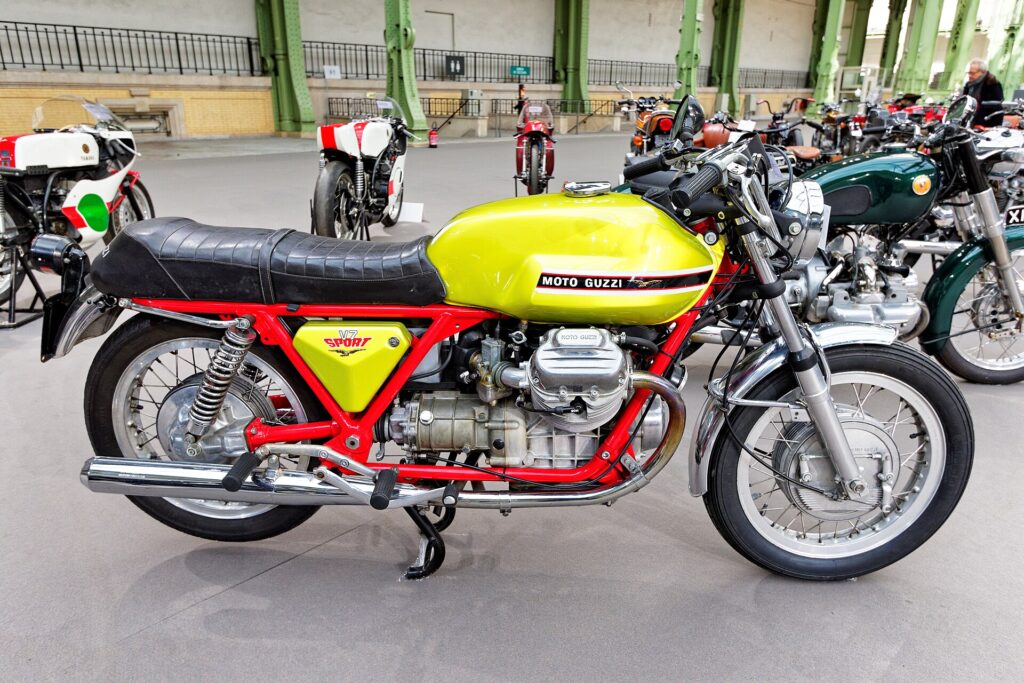
Photo: Thesupermat / Wikimedia Commons, CC BY-SA 4.0
Lino Tonti and the low frame
Everything changed when engineer Lino Tonti came to Moto Guzzi. He took the engine, made it 748 cc to fit the 750 class, and designed a completely new, very low twin-tube frame around it. To get the engine as low as possible, he moved the generator to the front and made the frame “hug” the cylinders.
The result was the 1971 V7 Sport. Low, long, with a five-speed gearbox, clip-on bars and a top speed close to 200 km/h. But the most important thing was its stability. In fast corners it stayed glued to the road like a train. Magazines of the time wrote that it had some of the best handling of any motorcycle in the world.
Telaio Rosso
The first 150 or so V7 Sports were built by hand, with a frame of special light chrome-molybdenum steel, painted red. Collectors call them “Telaio Rosso”, red frame, and today they are the rarest and most expensive V7 Sports. The rest had a black frame of ordinary steel.
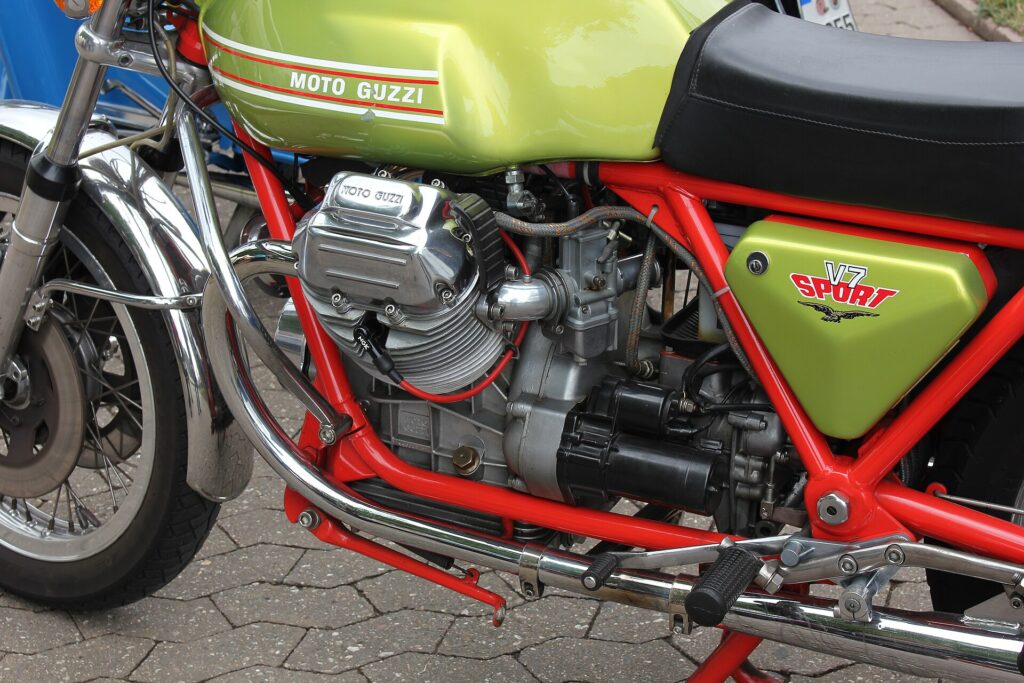
Photo: Lothar Spurzem / Wikimedia Commons, CC BY-SA 2.0 de
The legacy
The V7 Sport became the 750 S in 1974 and then the 750 S3. From the same frame and engine came the legendary Moto Guzzi Le Mans 850 in 1976, one of the most beautiful motorcycles of the 1970s. And Tonti’s frame, with changes, was used for more than thirty years.
Today Moto Guzzi still builds motorcycles in Mandello del Lario, still with a transverse V-twin and shaft drive, and still with the name V7 on one of its models. If you ever see a Moto Guzzi on the road, look at the two cylinders sticking out to the sides. It is the same idea that started in a military three-wheeler in the mountains, sixty years ago.
P.Kefalas