Toyota Land Cruiser FJ40: The Tool That Became a Legend Without Trying
on
I’ve said it before about the Cherokee XJ and I’ll say it again: the four-by-fours we love most are the ones that weren’t built to be loved. They were built to work. For farmers, geologists, armies, cattle ranchers in Australia and oilmen in the desert. The Toyota Land Cruiser FJ40 is perhaps the best example. A sheet-metal box nobody designed to be beautiful, which today is one of the most beautiful things you can park outside your house.
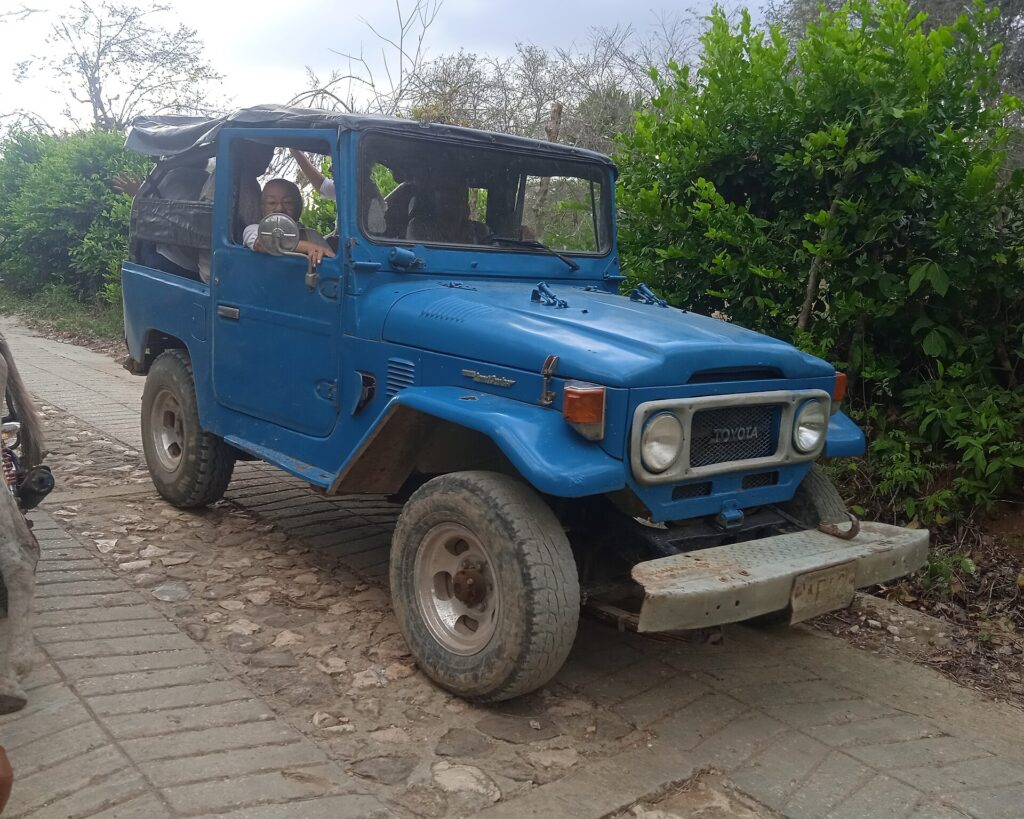
An FJ40 still working in the mountains of Colombia.
Photo: Ed Wessel Lied / Wikimedia Commons, CC BY 4.0
From copying the Jeep to finding its own way
Toyota started building four-wheel drives in the early ’50s with the BJ, a vehicle that made no secret of having looked closely at the American Jeep. In 1960, however, came the 40 series, and that’s where Toyota found its own voice. The FJ40 was slightly bigger than a Jeep CJ, built on a proper ladder chassis, with solid axles and leaf springs front and rear. Nothing clever, nothing strange. And that was exactly what was clever.
The most important new feature was the two-speed transfer case, the low range. With it the vehicle could climb slopes at walking pace without burning the clutch. Anyone who has ever gone up a rocky dirt track with one eye on the drop knows how important that is.
The heart: the F six-cylinder
The “F” in FJ40 is the engine: a 3.9-litre inline-six petrol engine with pushrods, heavy as an anvil. It wasn’t fast or economical. On tarmac the FJ40 is slow, noisy and drinks as if there were no tomorrow. But the F worked. In the heat, in the dust, on bad petrol, with oil that hadn’t been changed for a long time. Torque from idle and a durability that became legendary in Africa, the Middle East and South America.
Diesel engines came later: the 3.6-litre H six in 1972 and the 3-litre B four in 1974, and for those models the name changed to HJ40 and BJ40. If you find a BJ40 in good condition today, think about it seriously: it’s kinder on fuel and just as indestructible.
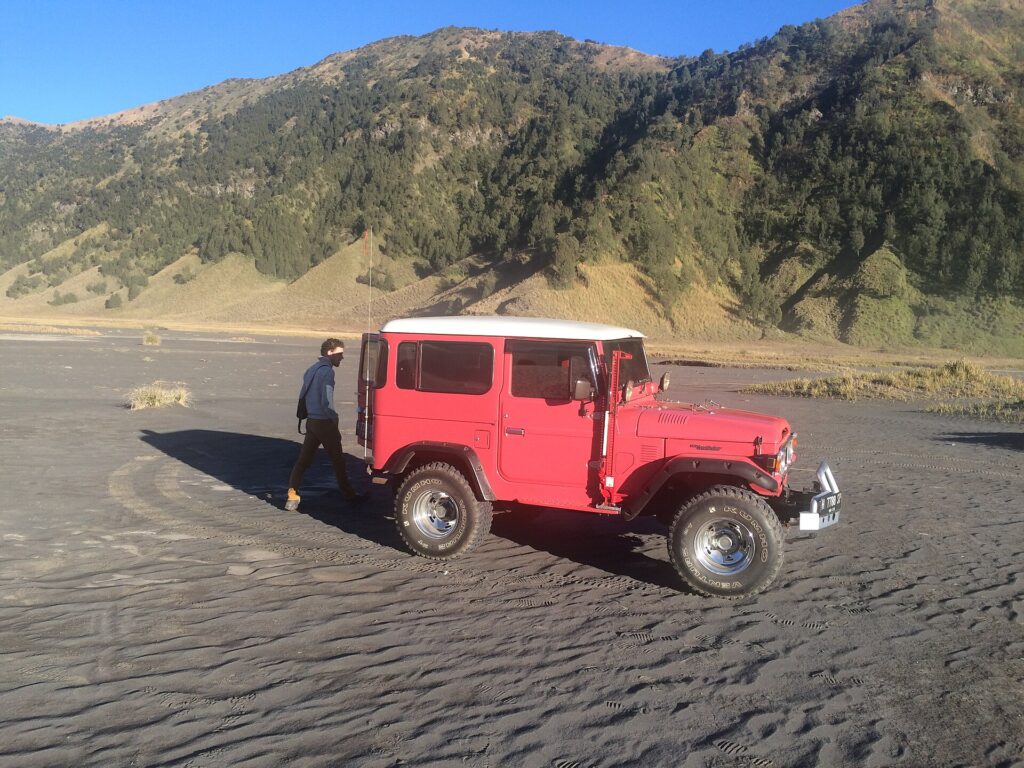
An FJ40 at Bromo volcano in Indonesia, in its natural habitat.
Photo: Hugo van den Bos / Wikimedia Commons, CC BY 2.0
Twenty-four years in Japan, forty-one in Brazil
The 40 series was built in short, medium and long wheelbase, with soft top, hard top, as a pick-up. In most markets production ended in 1984, when the 70 series took its place. In Brazil, however, it continued to be built locally as the Toyota Bandeirante, with Mercedes-Benz and later Toyota engines, until 2001. Forty-one years for the same basic design. Few cars in the world can say that.
Why it now costs as much as a sports car
Twenty years ago an FJ40 was just an old jeep. Today, especially in America, well-restored ones sell at prices that make you count the zeros twice. The reason is twofold: on the one hand the generation that saw them in documentaries about Africa has grown up and has money, and on the other most of them ended their lives as they should, working until they fell apart. There aren’t many good survivors.
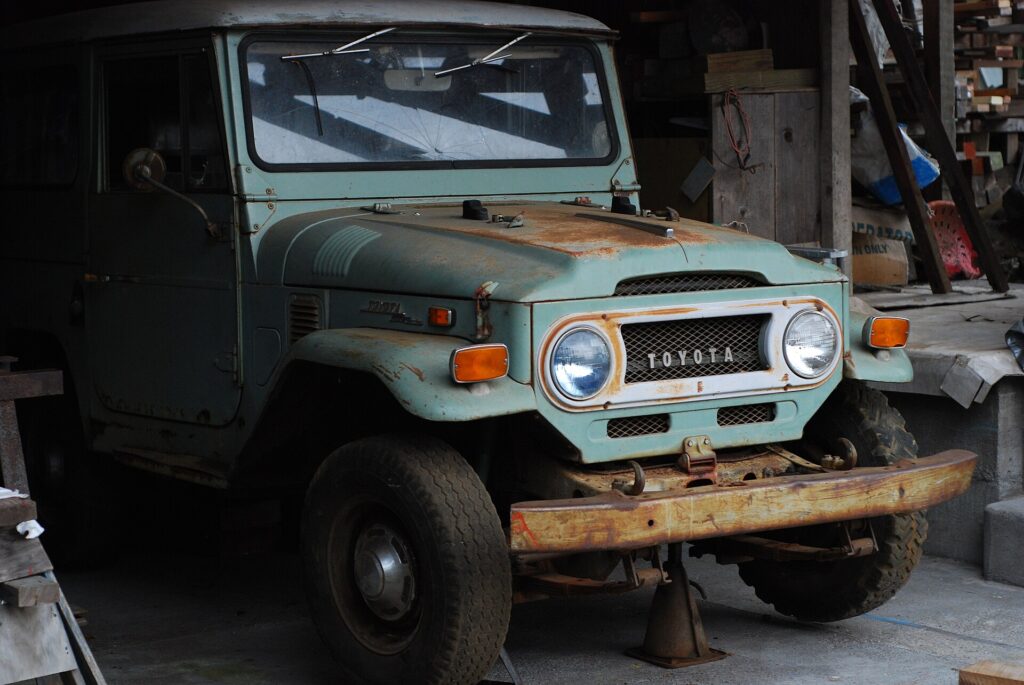
A 1969 FJ40 that worked as a farm truck in Hawaii.
Photo: User:Buickid / Wikimedia Commons, CC0
If you’re looking for one, rust is enemy number one. The FJ40 had almost no rust protection from the factory. Check the floor, the bottoms of the doors, the windscreen frame, the rear body around the wheel arches, and of course the chassis where the springs mount. The engine is rarely the problem. The steel around it is.
Every time I see an FJ40 with that typical white roof and the grille with TOYOTA spelled out in full, I think the same thing: this vehicle never tried to impress you. That’s exactly why it does.
P.Kefalas
Photo Credits: Ed Wessel Lied (Wikimedia Commons, CC BY 4.0) · Hugo van den Bos (Wikimedia Commons, CC BY 2.0) · User:Buickid (Wikimedia Commons, CC0)