Mercedes G W460: The Soldier That Became an Icon (and Was Even Built in Thessaloniki)
on
Today when we say “G-Class”, most people picture a black, shiny box with a V8 outside a club in Mykonos. I have nothing against that, but it’s not the G I love. My G is the first one, the W460: plain, square, with a diesel that sounds like a tractor and an interior you can hose out. A vehicle built to go where nothing else goes, not to be looked at.
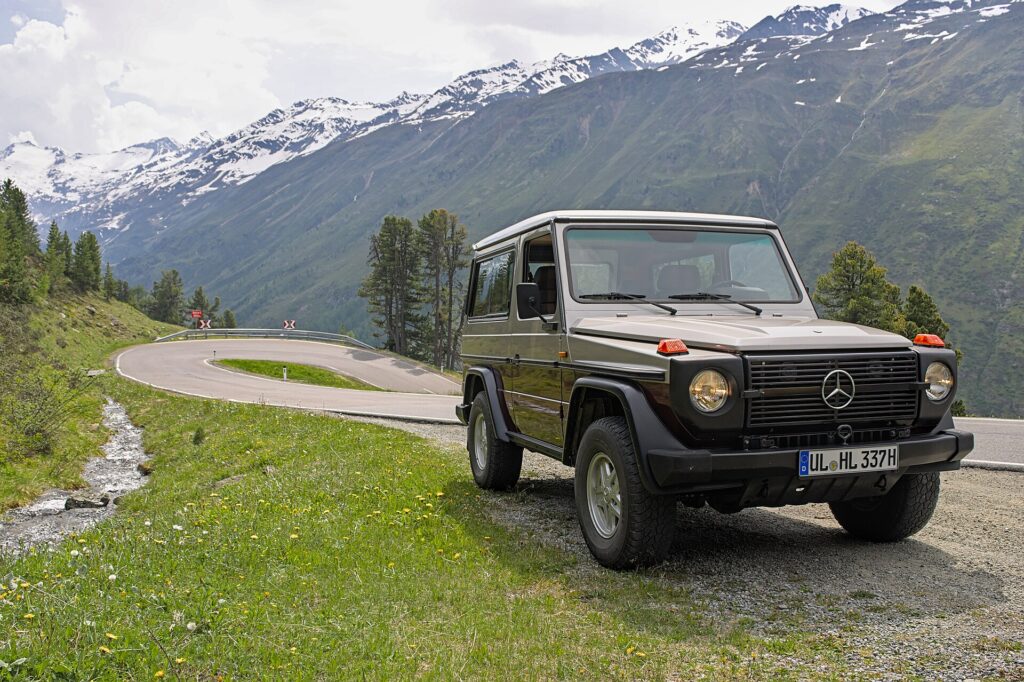
A Mercedes-Benz 250 GD (W460) where it belongs: in the mountains.
Photo: Alexander Migl / Wikimedia Commons, CC BY-SA 4.0
A Shah, a German company and an Austrian one
The story starts somewhere unexpected. The Shah of Iran, Mohammad Reza Pahlavi, who was also a major shareholder in Daimler-Benz, suggested that Mercedes build a military four-by-four. In 1972 Daimler-Benz signed a cooperation agreement with Austria’s Steyr-Daimler-Puch in Graz. The Germans in Stuttgart did the design and testing, the Austrians planned the production. The first wooden model was presented in 1973, and the vehicle was tested in desert, snow, mountains and mud for years.
By the time it was ready, Iran had changed regime and the big military order never came. So the G was launched as a civilian vehicle too. It was presented in 1979 in France, at an off-road proving ground near Toulon, and went on sale in September with three engines and five body styles: short and long, closed, soft-top and van. In some markets it was sold with the Puch badge.
Three lockers and a chassis like a bridge
Technically the G is simple and serious. Ladder chassis, solid axles front and rear, coil springs, a transfer case with low range. And something very few vehicles have even today: three fully locking differentials, front, rear and centre. Lock them, and whichever wheel has grip turns, and the G keeps moving while other four-by-fours dig holes.
The engines were familiar from Mercedes passenger cars: the 230 and 280 petrol engines and the 240 GD and 300 GD diesels. The five-cylinder 300 GD was the most popular. None of them was fast. A 240 GD with its roughly 72 hp on the motorway is a lesson in patience. In the mountains, though, in low range, speed simply doesn’t matter.
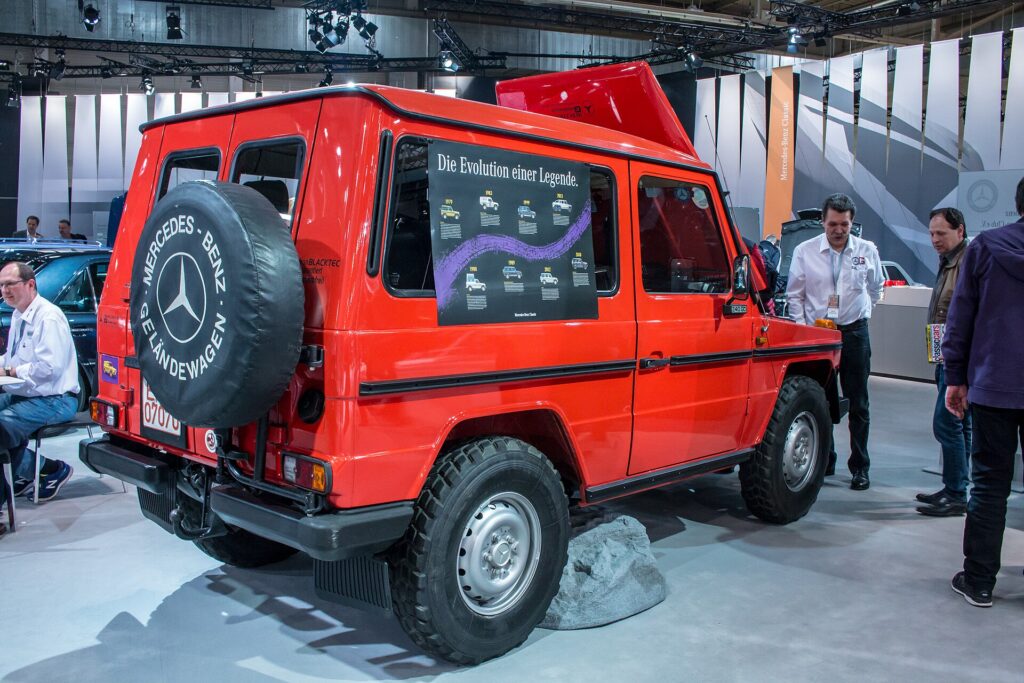
An early 240 GD at a classic car show.
Photo: Matti Blume / Wikimedia Commons, CC BY-SA 4.0
The Greek G
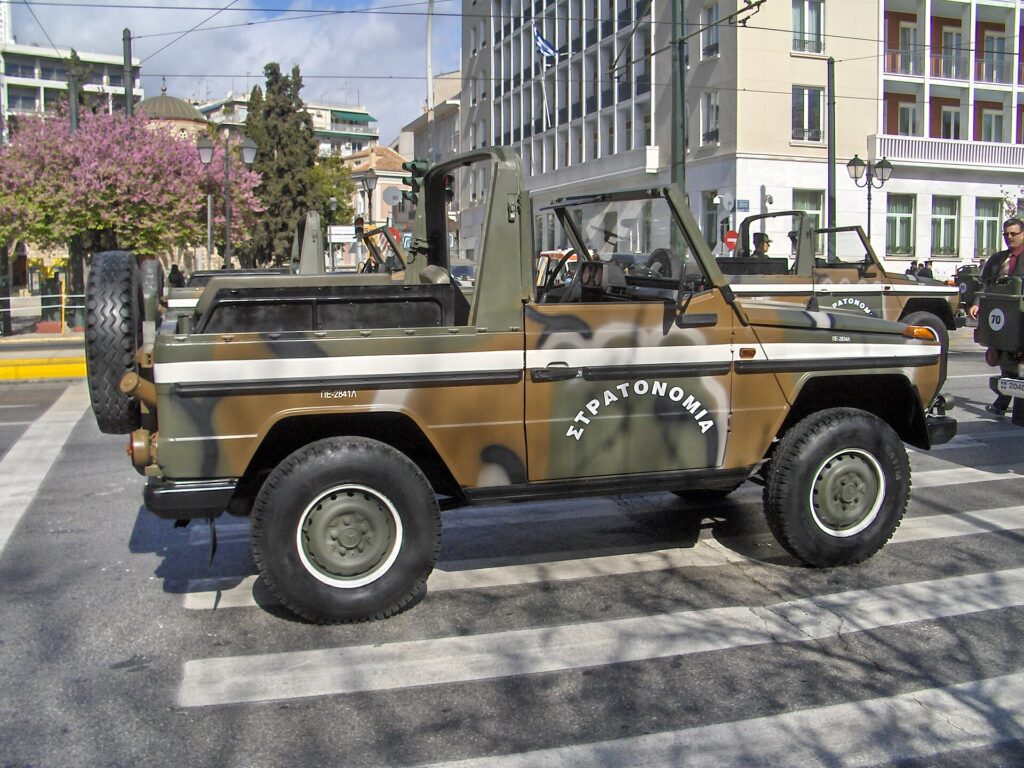
Here’s something many people don’t know. The Greek Army took the G as CKD kits, assembled in Thessaloniki by ELBO (formerly Steyr Hellas, a subsidiary of Steyr-Daimler-Puch). These versions initially had a 2.3-litre petrol engine and later a 2.9-litre five-cylinder diesel. If you did your military service in recent decades, you may well have travelled in one, in the back, without much comfort and with plenty of dust. There aren’t many classics with a “Greek passport”. The G is one of them.
Greek Army G-Class (240 GD, built by ELBO) at a parade in Athens.
Photo: Konstantinos Stampoulis (el:User:Geraki) / Wikimedia Commons, CC BY-SA 3.0 gr
From the army to the Pope
The G became famous worldwide in 1980, when Mercedes built a “Popemobile” on a 230 G for Pope John Paul II’s visit to Germany. During the ’80s it gained more comforts: automatic gearbox, air conditioning, fuel injection, nicer seats. In 1990 came the W463, more luxurious, with permanent four-wheel drive and ABS, while the basic W460 and the professional W461 continued for armies and working users.
The G has never stopped being built in Graz. In 2023 the 500,000th rolled out, painted in agave green as a tribute to the famous 1979 photo of a 240 GD jumping through the air.
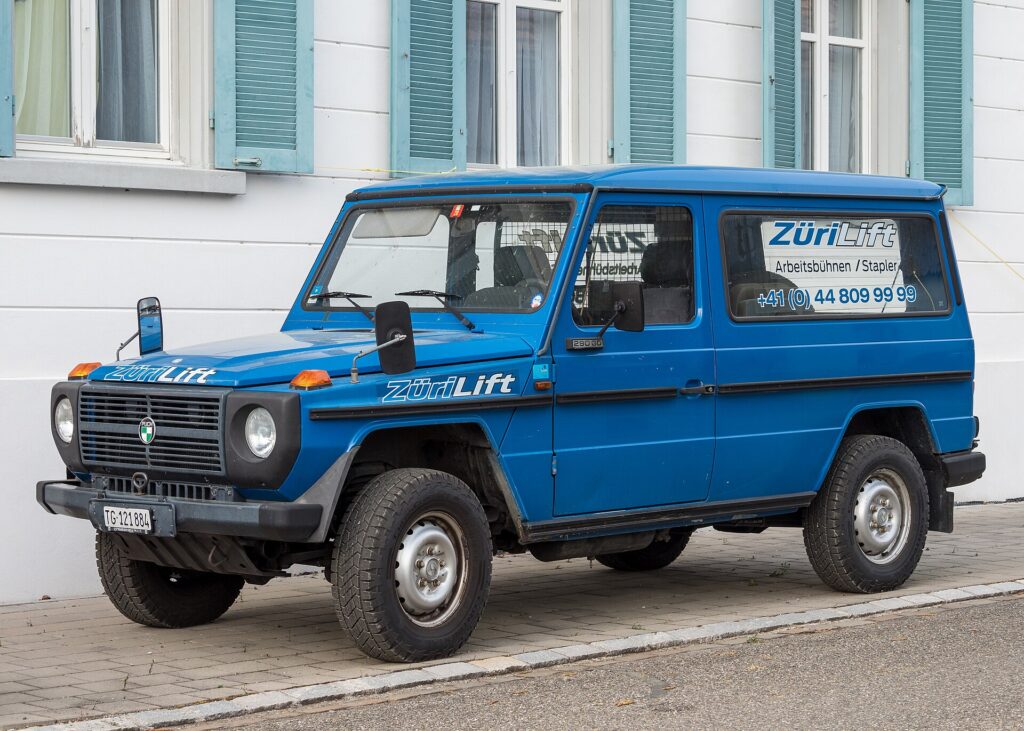
Steyr-Daimler-Puch 290 GD: the same G with the Puch badge.
Photo: JoachimKohler-HB / Wikimedia Commons, CC BY-SA 4.0
If you find one
W460s last a very long time, but they’re not invincible. The chassis rusts at the spring mounts and at the rear ends, the doors at the bottom, the floor under the mats, the windscreen seals. Test all the lockers: often they haven’t been used for years and they seize. Ex-military ones are usually tired but complete, and mechanically simple to fix.
The first G is one of the few classics you can use exactly as it was built: in the mud, in the mountains, in the fields. And that, for me, is the best compliment any vehicle can get.
P.Kefalas
Photo Credits: Alexander Migl (Wikimedia Commons, CC BY-SA 4.0) · Matti Blume (Wikimedia Commons, CC BY-SA 4.0) · Konstantinos Stampoulis (el:User:Geraki) (Wikimedia Commons, CC BY-SA 3.0 gr) · JoachimKohler-HB (Wikimedia Commons, CC BY-SA 4.0)