
Some motorcycles you buy to get somewhere. Others, in the 1920s, you bought to show the world who you were. The Brough Superior SS100 belonged firmly to the second group, and it was so good that a British magazine called it “the Rolls-Royce of motorcycles”. Best of all, Rolls-Royce itself, instead of sending lawyers, accepted the compliment.
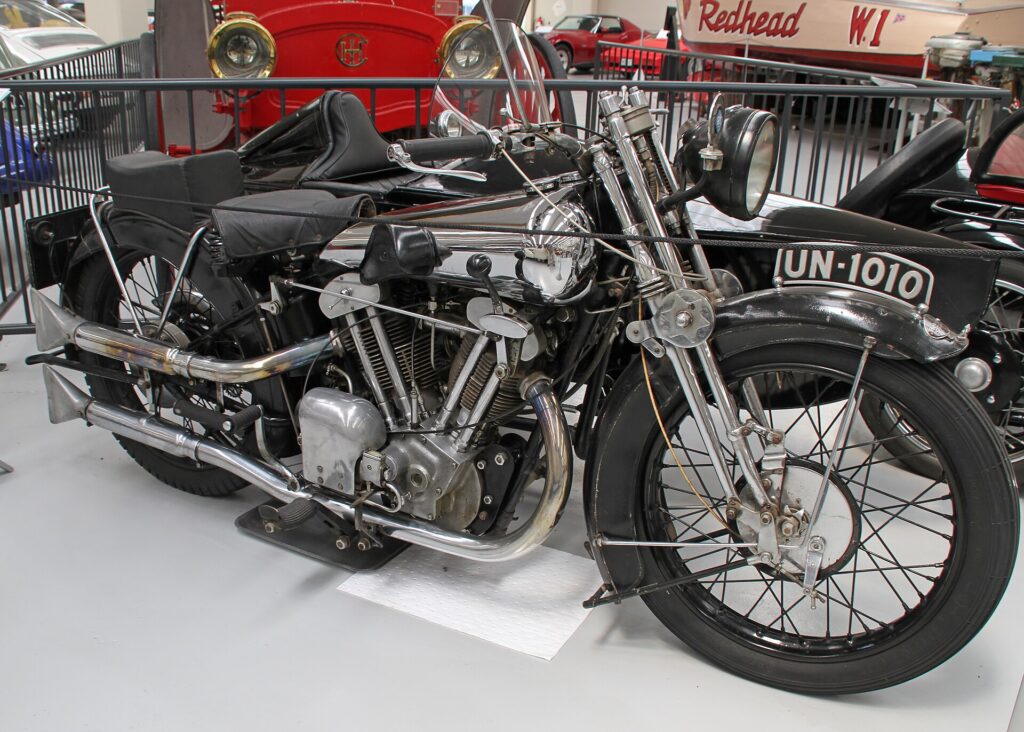
Photo: Tony Hisgett from Birmingham, UK / Wikimedia Commons, CC BY 2.0
A man who wanted the best
George Brough was the son of a Nottingham motorcycle maker. His father built simple, honest machines. George wanted something else: the fastest, most beautiful and best-built motorcycle in the world, with no compromise on cost. So in 1919 he set up his own company and, to make it clear who was superior, named it Brough Superior.
Brough did not make his own engines. He picked the best ones available, mainly JAP V-twins and later Matchless units, and fitted them to frames and suspension designed with an obsession for detail. Every machine was assembled twice: once for testing, then stripped, painted and built again for delivery.
SS100: a hundred miles an hour, in writing
The SS100 arrived in 1924, and the name was no empty boast. Every bike was tested before delivery and the buyer received a certificate confirming it had reached 100 mph, at a time when most cars struggled to reach 50.
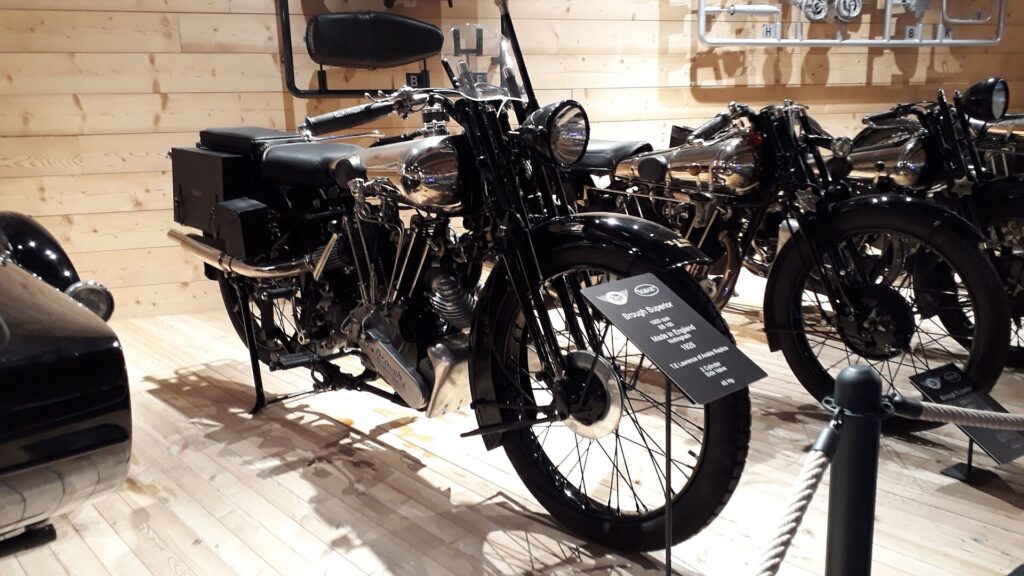
Photo: Rikki Mitterer / Wikimedia Commons, CC BY-SA 4.0
The JAP V-twin displaced roughly 1,000 cc, the fuel tank had the rounded “nose” shape that has been copied countless times since, and the front fork was a Harley-Davidson-type design that Brough refined. By 1940, when the factory switched to war work, only about 380 SS100s had been made. Few, expensive and almost entirely hand-built.
Lawrence of Arabia
Brough Superior’s most famous customer was T. E. Lawrence, “Lawrence of Arabia”. He owned seven Broughs, named them “George I”, “George II” and so on, and wrote enthusiastic letters to George Brough about each new one. In May 1935, shortly after leaving the RAF, Lawrence crashed his SS100 on a country road in Dorset while swerving to avoid two boys on bicycles. He died six days later. The eighth Brough he had ordered was never delivered.
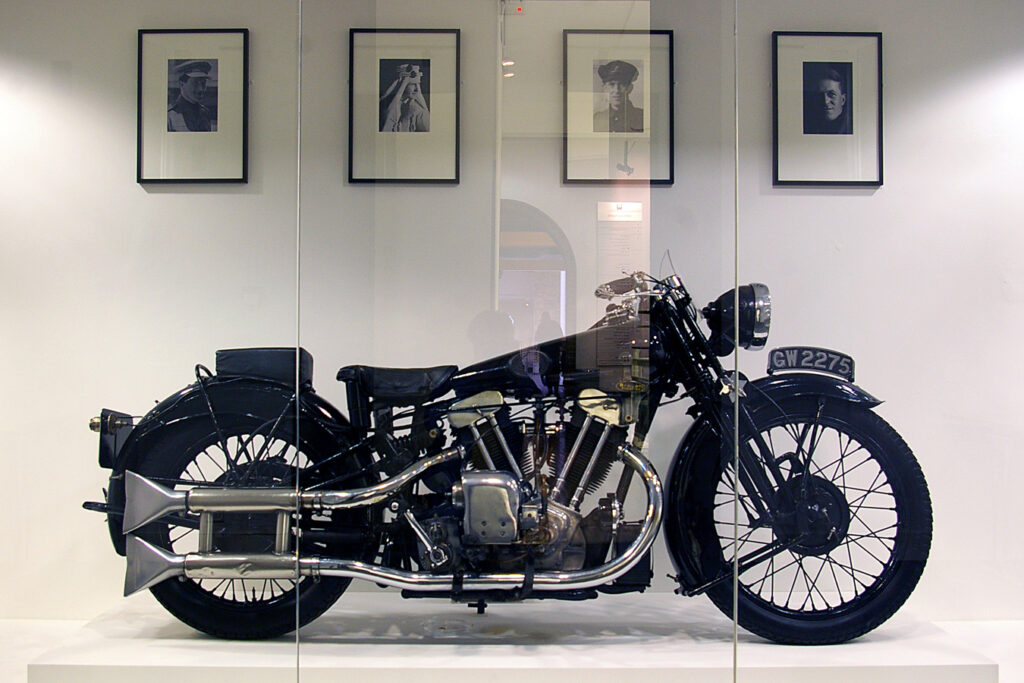
Photo: Joe MiGo / Wikimedia Commons, CC BY-SA 3.0
The accident had an unexpected legacy. The neurosurgeon who treated him, Hugh Cairns, began studying head injuries among motorcyclists. His work led to crash helmets being adopted, first by military dispatch riders and then by everyone. Every time we put on a helmet, in a way, we owe something to an SS100.
The SS100 today
Genuine SS100s are now among the most valuable classic motorcycles in the world. When one appears at auction, prices are measured in hundreds of thousands of pounds, and bikes with racing history or a famous owner go even higher. The name was revived in 2008 and the new company has built a modern SS100, but collectors want only one thing: an original, with frame and engine numbers that match the factory records.
If you ever see one up close at a museum or a show in England, look at the details: the nickel plating, the welds, the way the cables are routed. You will understand straight away why George Brough was not embarrassed to put the word “Superior” in the name.
P.Kefalas
Photo Credits: Tony Hisgett from Birmingham, UK (Wikimedia Commons, CC BY 2.0) · Rikki Mitterer (Wikimedia Commons, CC BY-SA 4.0) · Joe MiGo (Wikimedia Commons, CC BY-SA 3.0)