Carburettors: The Basics of Tuning Before You Pick Up a Screwdriver
on
Most of the classic cars we love have carburettors. And most of the problems I hear about from friends with classics start with the phrase “I just tweaked the screw on the carb a bit”. A carburettor isn’t magic. It’s a very clever, very simple component that works on physics. But to tune it properly, you first have to understand what it does and, above all, touch it last, not first.
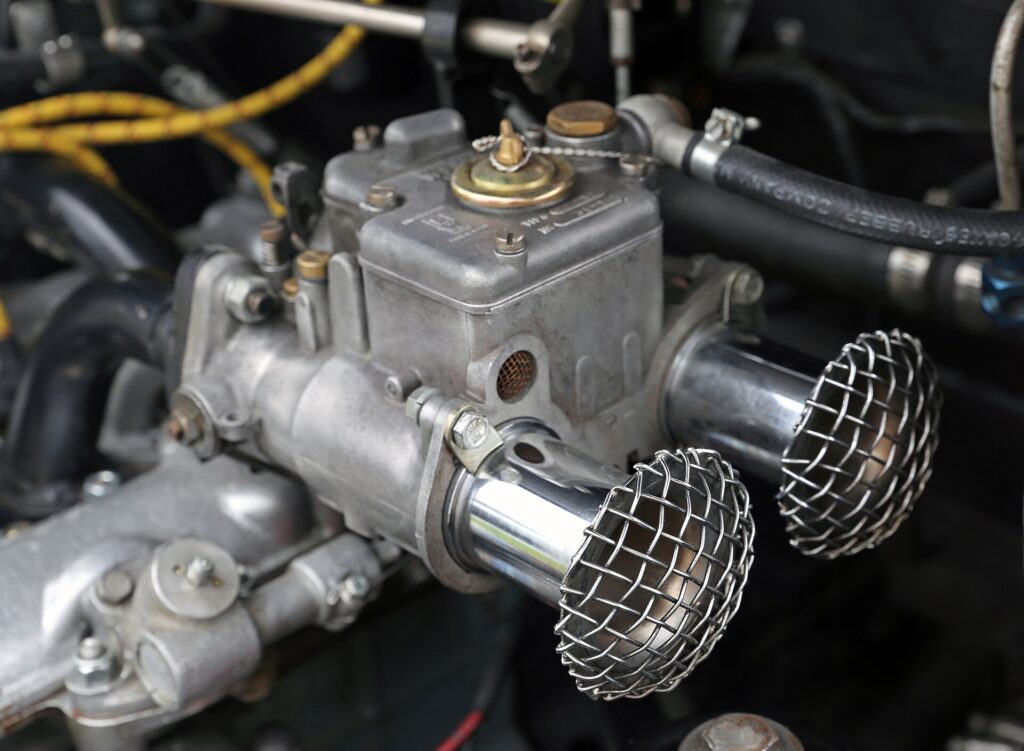
Twin-choke Weber 40 DCOE carburettor on an Abarth engine.
Photo: Mr.choppers / Wikimedia Commons, CC BY-SA 3.0
This isn’t a complete guide for every model. Every carburettor (Weber, Solex, SU, Dellorto, Zenith) has its own details, and your car’s workshop manual is always the first source. These are the basics, and the order in which you should do them.
How it works, in a nutshell
The air drawn in by the engine passes through a narrowing, the venturi. There the air speeds up and the pressure drops, and that small depression draws fuel from a nozzle, the jet. The fuel comes from a small float chamber that keeps the level constant. The throttle butterfly controls how much air passes. The more air, the more fuel is drawn. Simple, and yet it has worked for more than a century.
There are separate circuits for the different operating conditions: idle, main jet, the accelerator pump that squirts a little extra fuel when you press suddenly, and the choke for cold starts. SUs and Strombergs work a little differently, with a piston that rises and falls and a tapered needle, but the logic is the same: the right ratio of air to fuel.
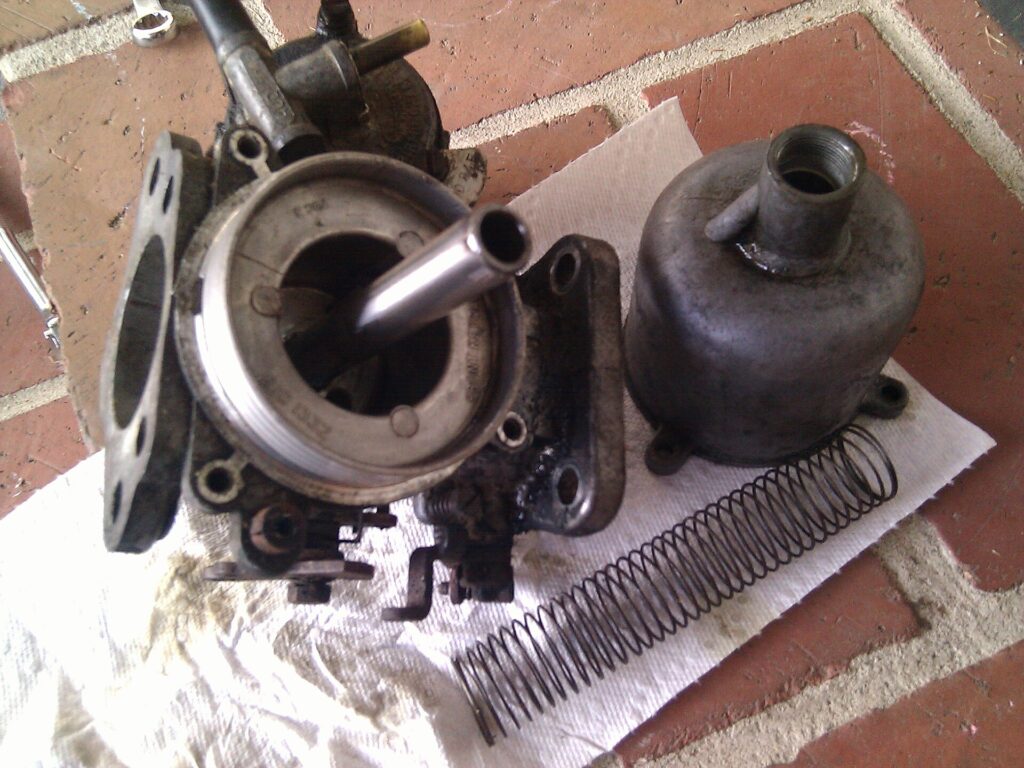
An SU carburettor taken apart: the piston and spring are visible.
Photo: Nathanael Burton / Wikimedia Commons, CC BY-SA 2.0
The golden rule: everything else first
The most common mistake is trying to fix with the carburettor a problem that isn’t in the carburettor. Before you touch it, make sure that:
The ignition is right. Points at the correct gap (or electronic ignition in good condition), correct timing checked with a strobe light, good plugs and leads, distributor cap and rotor without cracks or burns. A great many “carburettor problems” are really ignition problems.
The valves are adjusted to the clearances given by the manufacturer, and the engine has good compression.
There are no air leaks. A split vacuum hose, a worn inlet manifold gasket or a worn throttle spindle let air in without passing through the carburettor, and the mixture goes lean. Look for them with the engine idling, listening for a hiss.
The air filter and fuel supply are clean, and the float level is correct.
The tuning, in order
First warm the engine up properly, until the thermostat opens and the choke is fully off. Tuning a cold engine is wasted effort.
Use the idle speed screw to bring the revs close to what the manufacturer specifies. Then, with the idle mixture screw, turning in or out a little at a time, find the point where the engine runs highest and smoothest. Bring the revs back to the correct figure with the idle speed screw, and repeat once or twice. On many cars, once you find the point of maximum revs, you turn the mixture screw slightly towards lean until the revs just start to drop, for a cleaner burn. If you have an exhaust gas analyser (CO measurement), even better, because the ear is not a precision instrument.
If the engine has two or more carburettors, like the twin Webers on an Alfa or the SUs on an MG, they must first be synchronised so the same amount of air passes through each. This is done with a flow meter (Synchrometer type) or vacuum gauges, and by adjusting the throttle linkages. Without proper synchronisation, no amount of mixture adjustment will make the engine run smoothly.
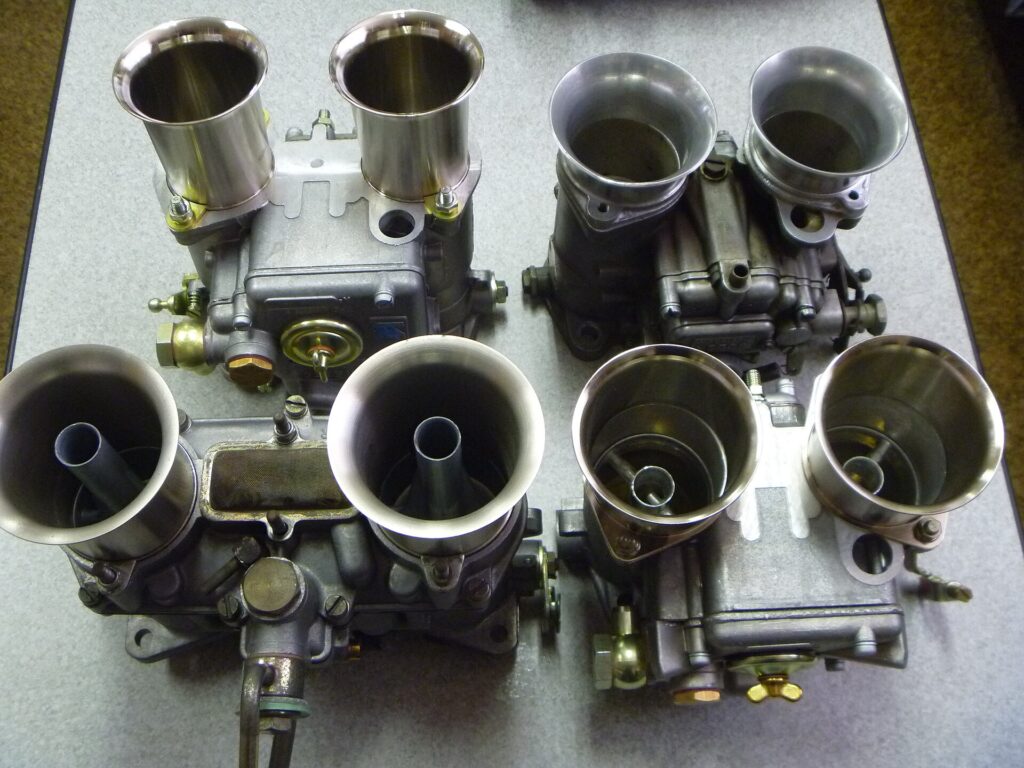
Weber and Solex, the carburettors that fed half of Europe.
Photo: Reforma.imufomot / Wikimedia Commons, Public domain
Reading the signs
Spark plugs tell you a lot. A light brown to grey colour is right. Black, dry soot means a rich mixture (or a choke that stays on). Very white, almost glazed, means lean and a risk to the engine. Black smoke from the exhaust and a smell of petrol: rich. Hesitation when you press the throttle and popping back through the carburettor: often lean, or a problem with the accelerator pump.
And one piece of advice that applies to any job with tools: before you turn any screw, count and write down how many turns it is from fully closed. That way, if you get lost, you can always go back to where you started.
A carburettor needs patience, cleanliness and order. But when a classic engine starts on the first turn, holds a steady idle and pulls cleanly all the way up, the satisfaction is like nothing else.
P.Kefalas
Photo Credits: Mr.choppers (Wikimedia Commons, CC BY-SA 3.0) · Nathanael Burton (Wikimedia Commons, CC BY-SA 2.0) · Reforma.imufomot (Wikimedia Commons, Public domain)