If there were one thing everyone who works with cars should learn, it would be this: weight is the enemy. We say it today as if it were obvious, but someone had to turn it into a philosophy of life. That was Colin Chapman, the founder of Lotus. The phrase attributed to him, “Simplify, then add lightness”, is one of the best pieces of engineering advice I’ve ever heard. And it applies to far more than cars. Anyone who has built furniture or a steel structure knows it: every part you don’t need is a part you’re just carrying around.
Colin Chapman at Zandvoort in the Netherlands, in the ’60s.
Photo: Joost Evers / Anefo / Wikimedia Commons, CC0
An Austin Seven and a girl
Anthony Colin Bruce Chapman was born on 19 May 1928 in Richmond, near London. His father ran a hotel and pub next to Hornsey railway station. He studied structural engineering, spent time in the RAF, and learned early on to think like an aircraft engineer, where every gram counts.
In 1948 he took an old Austin Seven, modified it and raced it in local events. He called it “Lotus”. Why? He never said clearly. The most romantic version says it came from his pet name for his girlfriend, and later wife, Hazel. Another, more prosaic, has to do with Buddhist texts. Take your pick. With the prize money he built the next one, and in 1952 he officially founded Lotus, which for years he ran in his spare time with a group of enthusiastic friends.
Lotus Seven: the absolute minimum
In 1957 came the car that, for me, sums up Chapman: the Lotus Seven. A tubular chassis, an engine, four wheels, two seats, a bit of aluminium around it all. No doors, almost nothing else. It was also sold as a kit, so the buyer could assemble it and avoid purchase tax. It weighed so little that with a modest engine it chased cars with twice the power. The idea lives on today with Caterham and dozens of copies around the world.
A 1960 Lotus Seven: the absolute minimum.
Photo: Brian Snelson from Hockley, Essex, England / Wikimedia Commons, CC BY 2.0
The Lotus 25 and Jim Clark
In Formula 1, Chapman brought one revolution after another. In 1962 he introduced the Lotus 25 with a monocoque chassis: instead of a tubular frame, the car’s skin itself carried the loads, as in an aircraft. Lighter, stiffer and safer for the driver. A few years later, everyone was building monocoques.
At the wheel of the 25 sat Jim Clark, the Scot who for many is the most naturally gifted driver of all time. Together they won the 1963 championship, and again in 1965 with the Lotus 33, the same year Clark also won the Indianapolis 500 in a Lotus. Their relationship was more than professional. When Clark was killed in 1968 in a Formula 2 race at Hockenheim, Chapman was devastated.
Jim Clark’s Lotus 25, with its revolutionary monocoque chassis.
Photo: John Chapman (Pyrope) / Wikimedia Commons, CC BY-SA 3.0
Aerodynamics from underneath
Chapman’s last big idea was ground effect. Together with Tony Rudd and Peter Wright, he designed cars whose underside was shaped like an upside-down aircraft wing, with side “skirts” sealing the air. The car was literally sucked onto the tarmac. The Lotus 79 dominated in 1978 and gave Mario Andretti the title. In total, with Chapman running the team, Lotus won seven constructors’ championships and six drivers’ titles.
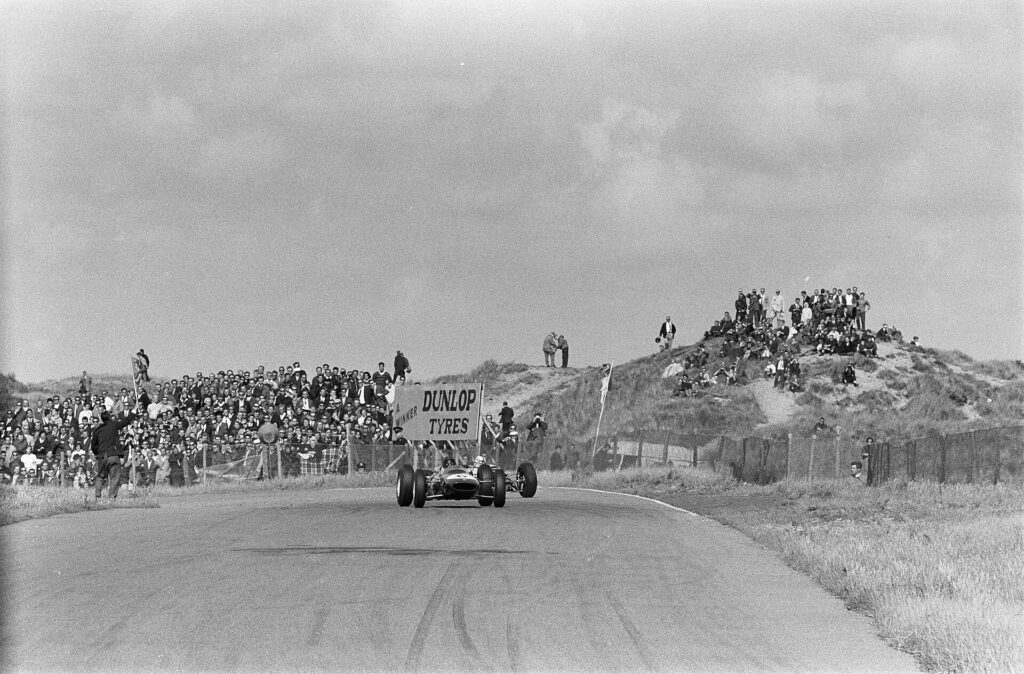
Jim Clark in a Lotus at the Dutch Grand Prix, Zandvoort, 1963.
Photo: Harry Pot for Anefo / Wikimedia Commons, CC0
The dark side
It wouldn’t be fair to write only the good things. Chapman’s cars were light, but often fragile too, and some drivers paid dearly for that lightness. And in his last years he became involved with John DeLorean in building the DMC-12 (which we’ve covered on this site), in a story involving British government money that disappeared. Chapman died of a heart attack on 16 December 1982, only 54, before the case reached the courts.
With the good and the bad, Colin Chapman changed the way we think about the car. Every time an engineer removes an unnecessary kilo from a design, without knowing it, he’s doing a little bit of Chapman.
P.Kefalas
Photo Credits: Joost Evers / Anefo (Wikimedia Commons, CC0) · Brian Snelson from Hockley, Essex, England (Wikimedia Commons, CC BY 2.0) · John Chapman (Pyrope) (Wikimedia Commons, CC BY-SA 3.0) · Harry Pot for Anefo (Wikimedia Commons, CC0)