I’ve written about several Ferraris on this site: the 250 GTO, the F40, the 400 Superamerica. At some point I had to write about the man behind them. Not because he was likeable, because from what you read he wasn’t always, but because without him the history of the car would be poorer. Enzo Ferrari wasn’t an engineer, nor a designer. He was something rarer: a man who knew how to get the best out of others, and who all his life put racing above everything.
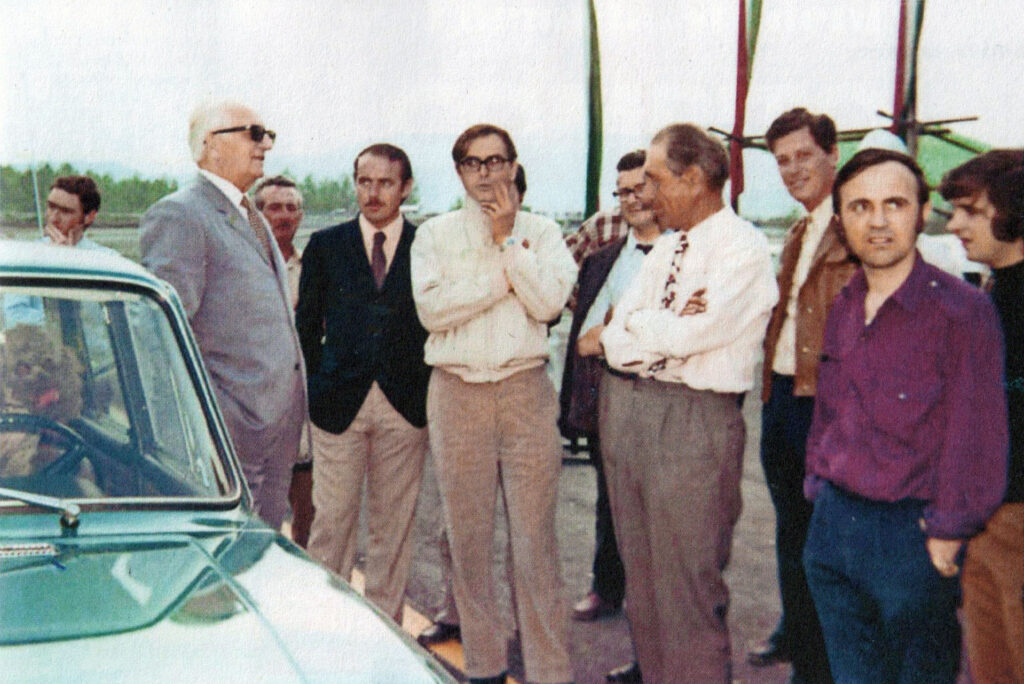
Enzo Ferrari (left) with engineer Gian Paolo Dallara at the Varano de’ Melegari circuit.
Photo: Unknown authorUnknown author / Wikimedia Commons, Public domain
From Modena to Alfa Romeo
He was born in Modena on 18 February 1898 (the birth certificate says the 20th, because a snowstorm delayed the registration, as the family story goes). After the First World War he asked Fiat for a job and was turned down, something I imagine he never forgot. He found work as a test driver for a small company in Milan, and in 1920 joined the Alfa Romeo racing department as a driver.
As a driver he was good without being top class. He won his first important race in 1923 at Ravenna, and 1924 was his best year. The deaths of colleagues, such as Antonio Ascari in 1925, affected him deeply, and little by little he moved from the steering wheel to organisation.
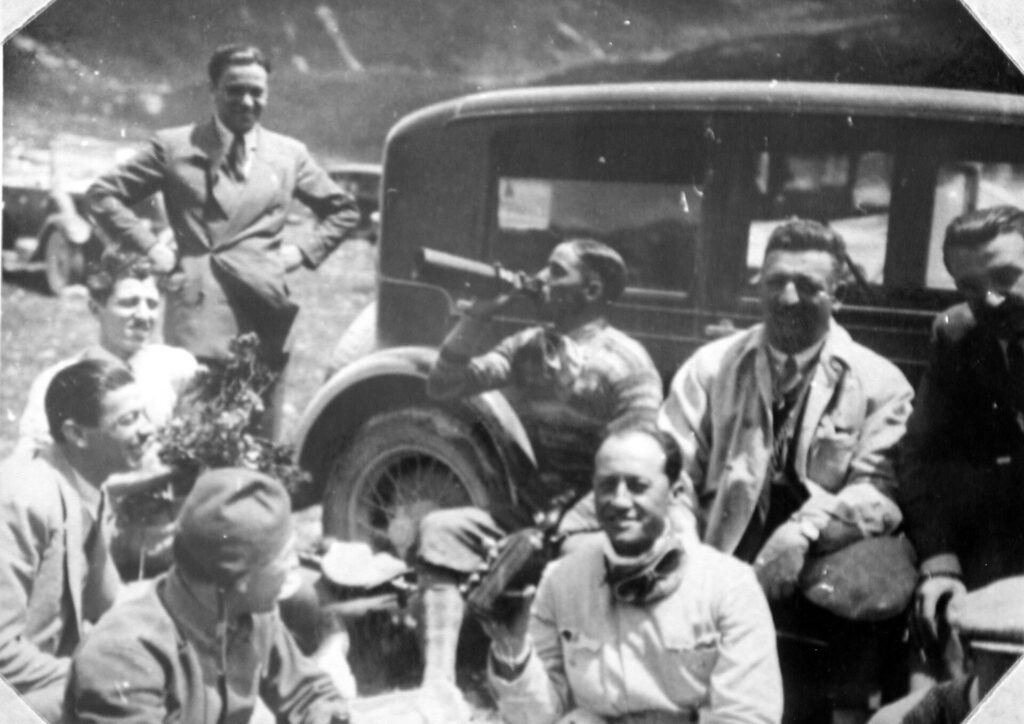
Alfa Romeo drivers between the wars. Fifth from left Tazio Nuvolari, sixth Luigi Arcangeli and seventh Enzo Ferrari.
Photo: / Wikimedia Commons, Public domain
The Scuderia and the prancing horse
In 1929 he founded Scuderia Ferrari, a team that raced Alfa Romeos on behalf of the factory and wealthy drivers. That’s when the badge with the rearing horse appeared. The horse had been the emblem of Francesco Baracca, an Italian flying ace of the First World War who was killed in 1918. According to Ferrari himself, Baracca’s mother suggested he put it on his cars for luck. Ferrari added the yellow background, the colour of Modena.
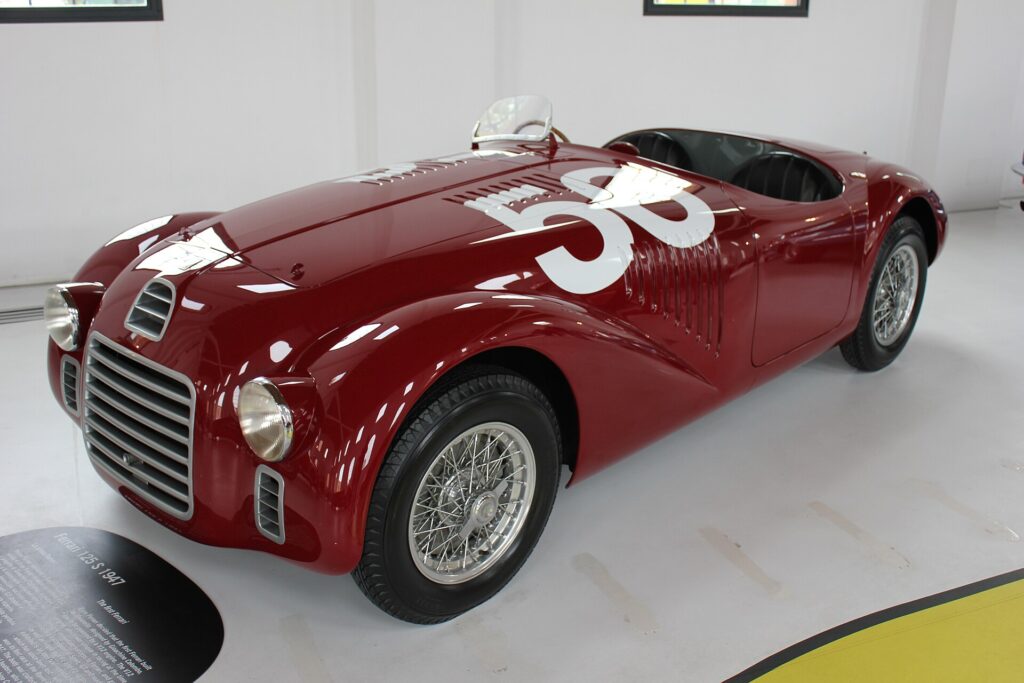
In 1939, after disagreements with Alfa’s management, he left and founded his own company, Auto-Avio Costruzioni, agreeing not to use the Ferrari name in racing for a few years. After the war, in 1947, the first car bearing his name came out of the Maranello factory: the 125 S, with a small 1.5-litre V12. From then on, the V12 became his signature.
The Ferrari 125 S of 1947, the first car to carry the Ferrari name.
Photo: Christine und Hagen Graf from Fitou, France / Wikimedia Commons, CC BY 2.0
Cars to pay for the racing
Ferrari used to say, with some exaggeration, that he sold road cars only to fund the racing team. But he believed it. The first big wins came quickly: Le Mans in 1949, Formula 1 championships with Ascari, Fangio, Hawthorn and Phil Hill. Ferrari won Le Mans six times in a row, from 1960 to 1965.
The British called him “Il Drake”, after the privateer Francis Drake, because with a small company he beat the big ones. The Italians called him “Il Commendatore”. He hardly ever went to the races, following them by telephone and on television. He nearly always wore dark glasses.
Dino, Ford and Fiat
The greatest wound of his life was the death of his son Alfredo, whom everyone called Dino, in 1956 at the age of 24, from muscular dystrophy. Ferrari gave his name to V6 engines and to a whole range of cars. It’s said he visited his grave every day.
In 1963 Ford tried to buy Ferrari. The negotiations went a long way, until Ferrari realised he would lose control of the racing team, and blew them up. Henry Ford II was so angry that he built the GT40 to beat him at Le Mans, and did so in 1966. In the end, in 1969, Ferrari sold 50% of his company to Fiat, the same company that had turned him down fifty years earlier, while keeping control of the racing.
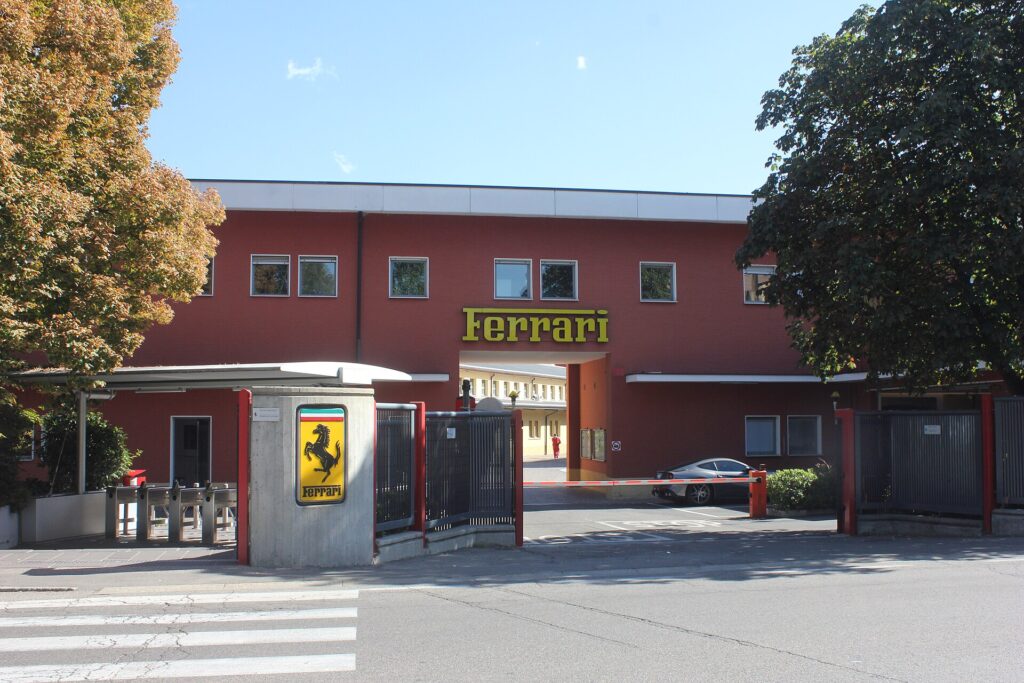
The entrance to the Ferrari factory in Maranello.
Photo: CAPTAIN RAJU / Wikimedia Commons, CC BY-SA 4.0
The legacy
Enzo Ferrari died on 14 August 1988, aged 90. The last car he approved was the F40. Today the prancing horse badge is one of the most recognisable in the world, and the Scuderia is the only team that has raced in Formula 1 since the very first championship in 1950.
Difficult, stubborn, often unfair to his people. But when I hear a Ferrari V12 rev, I understand why so many talented people agreed to work for him. He didn’t sell cars. He sold a dream, and that dream was racing.
P.Kefalas
Photo Credits: Unknown authorUnknown author (Wikimedia Commons, Public domain) · Christine und Hagen Graf from Fitou, France (Wikimedia Commons, CC BY 2.0) · CAPTAIN RAJU (Wikimedia Commons, CC BY-SA 4.0) · (Wikimedia Commons, Public domain)